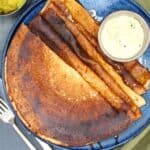
Quinoa dosa
This crispy, thin quinoa dosa needs just five ingredients, including rice and lentils, and it is loaded with healthy protein. You can ferment the batter to make it probiotic.
Servings: 20 dosas
Calories: 57kcal
Equipment
- Bowl
- Blender
- Skillet (cast iron skillet, well-seasoned, or non-stick skillet)
Ingredients
- 1 cup quinoa
- ½ cup urad dal (black gram dal)
- 2 tablespoon toor dal (pigeon peas)
- 2 tablespoon chana dal (Bengal gram dal)
- ½ teaspoon fenugreek seeds or methi seeds (optional if not fermenting)
- Salt to taste
Instructions
- Rinse the dals and quinoa and place in a bowl with fenugreek seeds, if using, and enough water to cover by at least two inches. Set aside to soak at least three hours or overnight.

- Drain and place the quinoa and lentils in a blender with enough water to keep the blades moving. Blend into a smooth paste. You can always mix in more water later if your batter is too thick. The dosa batter should have the consistency of a thin pancake batter minus the lumps.

- You can make the dosas rightaway after blending, or you can ferment the batter overnight to get healthier dosas. To ferment the batter, cover the bowl with a lid and place in a warm spot in your kitchen, or in a cold oven with the light turned on, overnight. The batter will become puffy after 8-10 hours, indicating that it is teeming with good-for-you bacteria. Stir in salt to taste at this point.
- To make the dosas, use a paper towel or the cut surface of half a potato or onion to rub a tiny bit of oil on the surface of a griddle. There should be no visible oil, you are just seasoning the griddle to ensure the dosa doesn't stick.
- Heat the griddle until water splattered on the surface sizzles and evaporates rightaway. Using a ladle with a rounded bottom, place about ⅓rd cup of the dosa batter in the center of the griddle. Using the bottom of the ladle, start spreading the batter into a round, moving outward from the center in a spiral motion. Your dosa should be rather thin and crepe-like. Don't worry if you don't get this perfect the first few times--you'll get better with practice.

- Sprinkle a few drops of oil around the edges of the crepe. This helps the edge brown and become all crispy, and it helps release the dosa crepe. You can also use cooking spray.

- Let the bottom cook until golden-brown. If your dosa is thin enough, you don’t really need to cook the other side, but if it is thick, flip it over and cook another 30 seconds.

Notes
- Quinoa is typically available in white, red and black colors. You can use quinoa of any color in this recipe.
- Wash the quinoa thoroughly before use. This is best done by placing the quinoa in a fine-mesh colander and rinsing it under running water. Quinoa has a natural, protective coating of phytochemicals called saponins, which can make the quinoa taste bitter. But it's a problem easily taken care of by simply rinsing the quinoa.
- If using cooking spray instead of oil, on a gas stove, turn the heat all the way down or off before spraying around the edges so you don't accidentally spray the flame.
- To make softer dosas, add ¼ cup poha or flattened rice. You can also make the quinoa dosas thicker if that's how you like them.
Nutrition
Serving: 1 quinoa dosa | Calories: 57kcal | Carbohydrates: 10g | Protein: 3g | Fat: 1g | Saturated Fat: 1g | Sodium: 2mg | Potassium: 49mg | Fiber: 2g | Sugar: 1g | Vitamin A: 2IU | Vitamin C: 1mg | Calcium: 11mg | Iron: 1mg