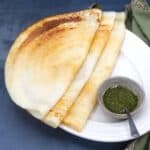
Dosa Recipe
Learn step by step how to make the best south Indian dosa. My easy but authentic recipe makes the softest dosas with crispy edges.
Servings: 20 8-inch dosas (approx)
Calories: 89kcal
Equipment
- Large bowl
- Blender
- 1 Cast iron griddle (or a non-stick griddle. Use a 10- or 12-inch griddle or skillet)
Ingredients
- 2 cups rice (I used white basmati rice. See notes on what types of rice to use.)
- ½ cup poha (flattened rice)
- ½ cup urad dal (black gram dal)
- 2 tablespoons chana dal (Bengal gram dal)
- ½ teaspoon fenugreek seeds (methi seeds)
- 1½ cups water
- Salt to taste (Not necessary, but you can add it if you like. Add the salt after fermentation as it can inhibit the growth of friendly bacteria).
- Vegetable oil or cooking spray for sprinkling around edges of dosa
Instructions
- Mix all the ingredients for the dosa in a large bowl. Pour enough water to cover by 2-3 inches. Cover and set aside to soak for 8 hours.
- After the ingredients have soaked strain them. Place them in a blender with a cup of water--I like to break this up in batches, so I do half the ingredients at a time with half a cup of water each.
- Blend the batter for 30 seconds, preferably in a high-powered blender, then continue blending in 10-second spurts until you reach the desired consistency. The batter should feel very smooth but you should feel a tiny amount of grittiness from the rice when you rub it between your fingers. This will result in crispy dosas.
- The batter should be thick but pourable. If you find that it's too thick add the remaining half cup of water slowly.
- Return the batter to the bowl and cover it. Now place it in a warm place to ferment for at least 8 hours or overnight. See notes for more guidance on how to do this.
- The fermented batter will be puffy. Stir it a few times to deflate the puffiness so you can shape the dosas more easily.
- Heat a griddle to the point where drops of water sprinkled on it sizzle and evaporate within five seconds. Do not oil the griddle.
- Pour a ladleful of the batter in the center of the griddle. Quickly, moving outward in a spiral fashion, spread the dosa using the bottom of the ladle. A rounded ladle works best for this.
- Sprinkle a few drops of oil around the edges of the dosa. You can also spray cooking spray around the edges but turn down the heat while you do this so you don't get the spray directly on the gas flame.
- Once the dosa edges look lacy and golden-brown and the top has dried out completely loosen the dosa from the griddle gently with a flat spatula and remove to a plate.
- Serve hot.
Video
Notes
-
- Traditionally Tamilians use short-grain or medium-grain rice or parboiled rice to make dosa. Different varieties of rice result in very minor differences in texture and flavor in a dosa and, to me, that's not worth keeping one more variety of rice in my pantry, so I just use basmati rice -- brown, light brown or white. Sona masoori rice works too.
-
- Poha is flattened rice, and it gives a lovely, silky texture to the dosa. You can skip it but I recommend looking for it online or in Indian stores.
Nutrition
Serving: 1dosa | Calories: 89kcal | Carbohydrates: 17g | Protein: 2g | Fat: 1g | Saturated Fat: 1g | Sodium: 6mg | Potassium: 23mg | Fiber: 1g | Sugar: 1g | Vitamin A: 47IU | Vitamin C: 1mg | Calcium: 9mg | Iron: 1mg