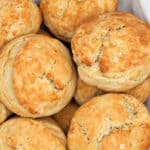
Vegan biscuits recipe
These vegan biscuits melt in the mouth with their flaky texture and buttery layers. The recipe riffs off a classic southern buttermilk biscuit and it tastes so authentic.
Servings: 12 biscuits
Calories: 158kcal
Equipment
- Large mixing bowl
- 2½-inch cookie cutter or biscuit cutter
- Baking sheet
Ingredients
- 2½ cups unbleached all purpose flour (plus more for dusting)
- 2 teaspoon baking powder
- ½ teaspoon baking soda
- ½ teaspoon salt
- 6 tablespoon vegan butter (very cold, straight from the refrigerator. Cut into small cubes just before adding to flour)
- 1 cup non-dairy milk (cold, straight from the refrigerator. Use any milk of your choice. I used oat milk.)
- 1 teaspoon apple cider vinegar
Optional wash
- 1 teaspoon oil
- 1 teaspoon non-dairy milk
Instructions
- Mix the non dairy milk with the vinegar and set aside in the refrigerator for a couple of minutes to curdle.
- Place the flour in a bowl with the baking powder, baking soda and salt. Whisk together.

- Add the butter to the bowl and, using a fork or a pastry-cutter, "cut" the butter into the flour until you have a coarse mixture with a few pea-size pieces of butter. You can also do this in the food processor--pulse the flour and butter three to four times, for five seconds each time, no more, until the butter has broken down into smaller bits.

- Slowly drizzle in the nondairy milk and vinegar mixture, and mix with a fork until the dough forms. If doing this in the food processor pour the milk through the feed tube while turning on the "pulse" button in short bursts. You may not need all of the milk.

- Form the dough into a disc.

- Wrap the biscuit dough in cling wrap, flatten into a disc, and place in the refrigerator for 5-10 minutes.

- Preheat oven to 450 degrees Fahrenheit/230 degrees Celsius.
- On a floured surface, roll out the dough about ¾-inch thick. Use a 2 ½-inch cookie cutter to cut out biscuits. Roll up dough scraps and cut more biscuits. You should get a total of 12 biscuits.

- Place the biscuits at least an inch apart on a baking sheet. If using optional wash, which will give the biscuits a richer, golden color, mix the oil and milk in a small bowl and brush the tops of the biscuits with the mixture. Bake the biscuits for 14 minutes until fluffy and golden.

- Serve the vegan biscuits hot or warm.
You can use a larger or smaller sized cookie cutter. The recipe yield will change depending on the size of the cookie cutter.
Notes
- The 5-10-minute chill in the instructions is the only dough-chilling period, not an additional chill. The total allows 10 minutes for this refrigeration step.
- When you cut the biscuits, flour the cookie cutter lightly and don't wiggle it into the dough as you cut--cut straight down in a firm, decisive motion. This will help the biscuits rise better, with flaky layers.
- Roll the biscuit dough on a lightly floured surface. You want enough flour to keep the dough from sticking, and you should also flour your rolling pin as well as scatter a bit of flour on top of the dough to make rolling easier.
- Round biscuits are classic, but you can also use a square or rectangle cookie cutter.
Nutrition
Serving: 1vegan biscuit | Calories: 158kcal | Carbohydrates: 21g | Protein: 3g | Fat: 7g | Saturated Fat: 1g | Sodium: 199mg | Potassium: 125mg | Fiber: 1g | Sugar: 1g | Vitamin A: 79IU | Vitamin C: 1mg | Calcium: 61mg | Iron: 1mg