

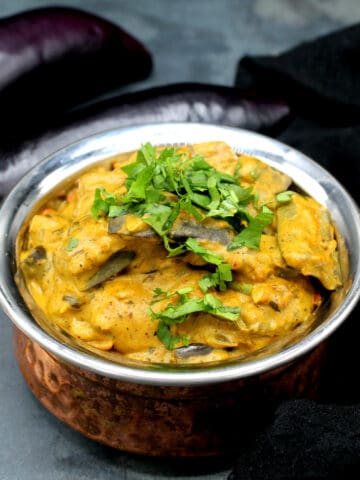
Bagara Baingan, a dish from the south Indian state of Andhra Pradesh, is made by simmering small eggplants in a spicy peanut and coconut curry sauce until they are butter-soft. The sauce has a vivid interplay of sweet, tangy, salty and spicy flavors.

Jump To
What is bagara baingan?
Bagara Baingan is a tasty south Indian dish of small Indian eggplants or brinjals in a creamy, spicy peanut, coconut and tamarind sauce. It originated in Andhra Pradesh, a state that was once ruled by Muslim rulers called nizams who, more formally, called this dish "baghar-e-baingan" or "baghare baingan," with "baghar" being the tempering for the sauce, and "baingan" being eggplants.
The nizams - or rather their hard-working and creative cooks - evolved a rich and distinctive cuisine that put Andhra Pradesh (then called the princely state of Hyderabad) on India's culinary map. Thanks to them, we can today enjoy such delicious recipes as Hyderabadi biryani.
Nizami food was meat-heavy but it included alluring vegetarian dishes, like mirch ka salan and this bagara baingan. These were usually served as sides with the meat entree. But bagara baingan is hearty enough to hold its own for a meal, especially when paired with rotis or with flavorful, protein-rich Indian flatbreads like besan roti or methi paratha.
Recipe card

Bagara Baingan
Equipment you'll need
- Wok or large skillet (with lid)
- Blender
Ingredients
- 12 Indian eggplants
- 1 red onion (finely chopped)
- 2 sprigs (about 24) curry leaves
- 1 teaspoon mustard seeds
- 1 teaspoon cumin seeds
- 1 tablespoon ground coriander
- 1 teaspoon ground cumin
- ½ to 1 teaspoon cayenne
- ½ teaspoon turmeric
- 2 teaspoons garam masala
- 1 tablespoon ginger garlic paste
- 1 tablespoon tamarind paste
- 1 tablespoon jaggery (or sugar)
- Salt to taste
- 2 tablespoons cilantro (chopped)
For the curry paste
- 1 red onion (chopped)
- ½ cup raw peanuts
- 2 tablespoons sesame seeds
- ¼ teaspoon fenugreek seeds or methi seeds
- ½ cup grated coconut
Instructions
Prep the eggplants
- Make two slits, crosswise, on the non-stem side of the eggplant, stopping short of making a clean cut, so the eggplant holds together at the base. Immediately immerse the eggplants in water so they don't turn brown.
- Heat four tablespoons oil in a wok or skillet over medium heat. Add the eggplants and fry them for 3-4 minutes, turning them around to ensure they fry evenly. Remove the eggplants to a plate lined with paper towels and pour the remaining oil into a bowl or jar for use in another recipe. The eggplants won't be fully tender but that's okay. They will continue to cook in the sauce.
Make the curry paste
- To the skillet (after removing the eggplants and oil), add the onions and a pinch of salt. Saute the onions until brown spots appear. Add peanuts and saute them for another minute.
- Add the sesame seeds and mix them in, then add coconut and mix it in too. Saute until the coconut has colored lightly. Keep a close eye because coconut can burn easily. Remove this masala to a plate. When it has cooled a bit, place in a blender with ½ cup water and blend into a smooth paste.
Make bagara baingan
- In a pot heat a tablespoon of the oil from frying the eggplants. Add mustard seeds and when they sputter add the cumin. You can use the same skillet used for frying the eggplant and the onions.
- Add onions and curry leaves. Add ½ teaspoon salt and saute until onions are soft. Then add ground coriander, ground cumin, cayenne, garam masala and turmeric. Mix well and saute for a minute.
- Stir in the ginger garlic paste, followed by the blended curry paste and tamarind. Mix well, then add in two cups water and mix again. Stir in the jaggery and let the sauce come to a boil. Continue to simmer the sauce, covered, until some darker liquid pools at the top. This indicates the raw ingredients are cooked. It should take about 10 minutes.
- Add the reserved eggplants to the sauce and mix in. Cover and continue to cook another 10 minutes or until the eggplants are very tender. Stir in the cilantro, check salt and add more as needed, and serve hot.
Nutrition Information
Ingredient notes
- Eggplants. You will need to source small, round eggplants from an Indian store or an Asian store. If you can't find the purple eggplants, you can use small, green Thai eggplants. Pick tiny eggplants - no more than two inches long, even smaller is better. The eggplants should be firm with bright skin and no dents or brown spots.
- Herbs: curry leaves and cilantro.
- Spices: mustard seeds, cumin seeds, ground coriander, ground cumin, garam masala, turmeric and cayenne (or any red chilli powder).
- Ginger garlic paste. If you don't have ginger garlic paste, blend four cloves of garlic and a 1-inch knob of ginger for this recipe.
- Tamarind paste. This adds a bit of tang and rich sweetness to the dish.
- Jaggery. Jaggery adds a hint of sweetness that's irresistible with eggplants. You can substitute it with sugar.
For the spice blend
- Red onions. You can substitute with yellow or white onions but red onions are preferred.
- Peanuts. Use raw peanuts. These add creaminess to the sauce, along with the sesame seeds.
- Sesame seeds. These, like the peanuts, add creaminess and nuttiness to the sauce.
- Fenugreek seeds. Fenugreek seeds are bitter, but they add complexity to the sweet, salty and tangy flavors we have going on here. Add no more than ¼th of a teaspoon.
- Grated coconut. You can use freshly grated coconut or use the frozen coconut found in the frozen aisle of the Indian grocery store.
Step by step instructions with photos

Make two slits, crosswise, in the eggplants, cutting about ¾ths of the way down but not all the way through. Put the eggplants in a bowl of water right away to keep them from turning brown.

Heat four tablespoons oil in a wok or skillet over medium heat. Add the eggplants and fry them for 3-4 minutes, turning them around to ensure they fry evenly. Remove the eggplants to a plate lined with paper towels and pour the remaining oil into a bowl or jar for use in another recipe. The eggplants won't be fully tender but that's okay. They will continue to cook in the sauce.

To the skillet (after removing the oil), add the onions and a pinch of salt. Sauté the onions until brown spots appear.

Add peanuts and sauté them for another minute.

Add the sesame seeds and mix them in.

Add coconut to the skillet and mix it in.

Sauté until the coconut has colored lightly. Keep a close eye because coconut can burn easily. Remove this masala to a plate. When it has cooled a bit, place in a blender with ½ cup water and blend into a smooth paste.

In a pot heat a tablespoon of the oil from frying the eggplants. Add mustard seeds and when they sputter add the cumin. You can use the same skillet used for frying the onions but I changed because I didn't want to add tamarind to my cast-iron kadhai.

Add onions and curry leaves. Add ½ teaspoon salt and saute until onions are soft.

Add ground coriander, ground cumin, cayenne, garam masala and turmeric. Mix well and saute for a minute.

Stir in the ginger garlic paste.

Add the coconut-sesame-seed paste and tamarind.

Mix well, then add in two cups water and mix again.

Stir in the jaggery and let the sauce come to a boil.

Continue to simmer the sauce, covered, until some darker liquid pools at the top. This indicates the raw ingredients are cooked. It should take about 10 minutes.

Add the reserved eggplants to the sauce and mix in. Cover and continue to cook another 10 minutes or until the eggplants are very tender. Check salt and add more as needed.

Stir in the cilantro.

Mix everything well and serve the bagara baingan hot.

Serve
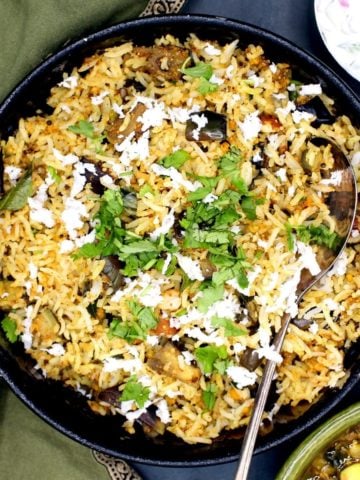
Bagara baingan is often eaten with biryani, and you can serve it with a vegan biryani like vegetable biryani, keema biryani or cauliflower biryani. I often serve it with a dal, like this dal tadka and basmati rice, or with roti or vegan naan.
Recipe FAQs
You can use Japanese eggplants or Chinese eggplants to make bagara baingan. Cut the eggplant into long slices of about 2 inches by an inch.
If you can't eat peanuts but can eat other nuts, substitute with raw cashews. If you are nut-free, use pumpkin seeds or melon seeds instead of the peanuts.
Bagara baingan tastes even better when it has had time to stand for a day or two. You can make it up to four days ahead of serving, or refrigerate it for four days after making it. Freeze for up to three months in a freezer-safe container. Thaw and reheat in the microwave or a saucepan before serving.
The sauce for bagara baingan has to be thick but still fluid, like a cake batter. The peanuts absorb water quickly so if it's too still too thick after you have added two cups of water, you can add some more water to thin it out.
More Indian eggplant recipes


First published June 23, 2009. Updated and re-published on Sept. 13, 2024.



Neena Singh says
Great recipe. Vaishali, you don’t mention when to add tamarind paste and jaggery into the sauce. Could you please clarify that. Thanks
Neena
Vaishali says
Hi, check out step 3 under "make baghara baingan" in the recipe card. You can also find it in the step by step instructions with photos.
Neena Singh says
Thanks. My mistake.
Sona says
Hi.. Vishali. Liked your idea of cast iron cooking
Have few question like what us that true blue kadhaii from India...where I can get that..?
And what's this iron double griddle come grill.
Again where I can get that. Thanks
Vaishali Honawar says
Hi Sona, I don't live in India so I unfortunately can't answer those questions. Perhaps a reader could help?
Nisha Tiwari says
HI VAISHALI,
JUST CHECK IF M NOT MAKING ANY MISTAKE, WHEN I CLICK ON THE HEADING "PAV" IN UR INDIAN BREAD RECIPE SECTION IT TAKES ME TO THIS "BHAGARE BAIGAN".
GOD BLESS
NISHA.
Vaishali says
Nisha, you were right. Thanks very much for letting me know-- I've added the correct link. 🙂
Vaishali says
Hi Swarna, Welcome!
Here's what I do: for the first time I season, I coat the pan generously with shortening like Crisco, heat up the oven to the highest it will go, then put the pan inside and leave it for an hour. It should really get smoking hot. Leave it in for several hours after turning off so it cools down-- at that temperature it is really too dangerous to touch.
When you take the pan out, use a scrubber and very hot water to rinse it out. Now place it on the stove and let it dry out completely. Spread a very thin layer of oil on it and store.
Remember, when your pan is new do not use soap on it. And try to mostly do "oily" stuff in it, like deep frying or sauteing, rather than poaching or boiling.
It will take a few uses for the pan to turn really black, but it will eventually. Remember to rinse, dry on heat, and oil your pan after every use for the first few times.
Hope that helps 🙂
Swarna says
Vaishali,
Love ur recipes.
Ur comment
"Everything stuck to it, didn't come off, and tasted funny. Still, I wasn't about to give up. One of the most magical things about cast-iron pans is, they are supposed to improve with use. And so I continued to season my pan and used it only to do oily stuff like deep-fry at the beginning"
I have same problem...pan is becoming gray...please give me tips on seasoning the vegan way....
--Swarna
Sia says
Vaish, ur bhagare baingan looks absolutely lip smacking! Makes me want to run to kitchen anc ook this again 🙂