

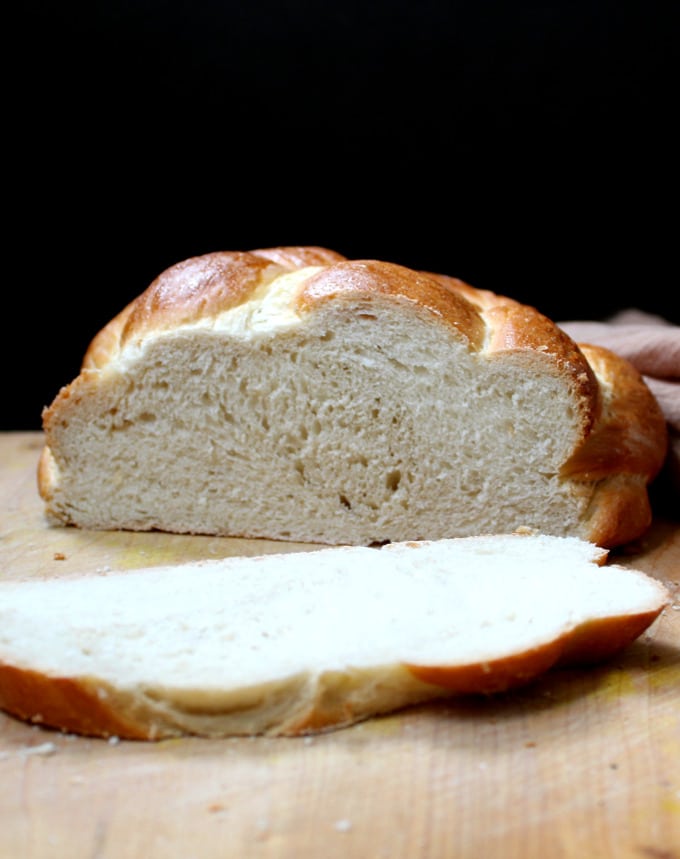
This Vegan Eggless Sourdough Challah has the perfect crust and fluffy crumb. Aquafaba stands in for the eggs.
You might also like these recipes for a classic vegan challah and vegan whole wheat challah.
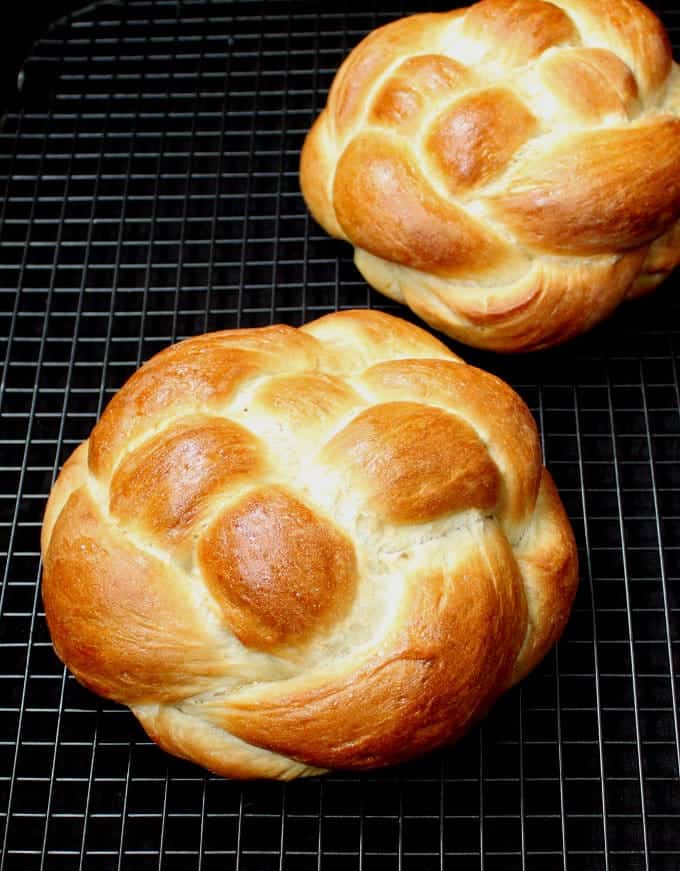
If you have a pot of sourdough starter sitting around, here's a great way to have it and eat it too: my Vegan Eggless Sourdough Challah.
Just like its French cousin, the brioche, the challah has always fascinated me. It's an extraordinary bread: delicate, tender, delicious, but it also relies quite heavily on eggs for flavor and texture, making it a bit of a challenge for the vegan baker.
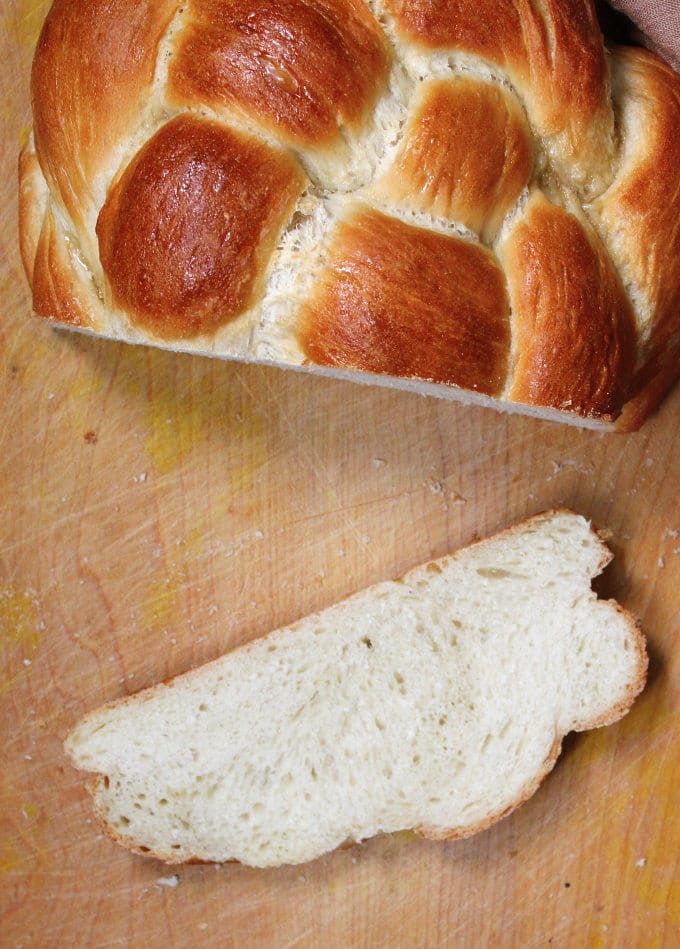
I know many of my readers share my passion for sourdough, not only for the wonderful flavor it imparts to breads, but also for its great probiotic benefits.
It is especially wonderful in this challah, where it imparts depth of flavor without adding any sourness. The challah is an elegantly sweet bread, and the flavor in these loaves is just as it should be. I went through a couple of trials with this recipe, producing bread that was delicious, but either didn't hold its shape very well after baking, or didn't have that great color. With this recipe, everything turned out just perfect (although my challah shaping skills do need more work).
The bread rises quite a bit in the oven, thanks to the sourdough, so as always while baking with sourdough, be prepared for a pleasant surprise when you pull it out of the oven.
Happy baking!
More vegan sourdough bread recipes
Recipe card
Vegan Eggless Sourdough Challah
Ingredients
- 1 cup sourdough starter (fed the day before you make the dough)
- ⅓ cup warm filtered or distilled water
- 2 cups bread flour
- 1-2 cups all purpose flour
- 9 tablespoon aquafaba (chickpea brine)
- ¼ cup maple syrup
- ¼ cup extra virgin olive oil
Instructions
- In a stand mixer or a large bowl, mix the sourdough starter with 1 cup bread flour and water. Cover the bowl tightly and let it stand overnight. If it is very warm where you are, leave it in the refrigerator overnight and let it stand on the countertop for another hour before proceeding.
- To the bowl, add the remaining 1 cup of bread flour and 1 cup of all purpose flour. Add the aquafaba, maple syrup and olive oil and knead until the dough comes together in a ball. Continue to knead at medium-low speed for 10 minutes in the stand mixer, or knead by hand. If the dough feels tacky, add more flour, a tablespoon at a time. You want a firm but smooth and elastic dough. A soft dough will not hold its shape after rising, so this is important.
- Shape the dough into a smooth ball and place in an oiled bowl, turning over once to coat the top with oil. Cover with cling wrap and place in a warm spot, like the oven with the pilot light turned on, for two hours or until the dough has doubled.
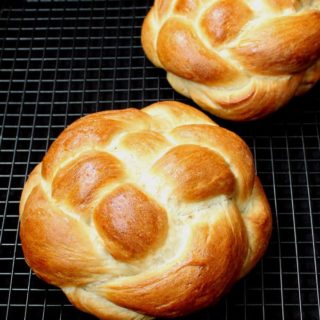
- Remove the dough to the countertop and knead it briefly. Divide it into eight balls and roll each out into a long strand. You can braid these to either form long loaves or round loaves like I did. I used the four-braid method to shape my two challah loaves (see recipe notes for the video I watched to shape these).
- Line a baking sheet with parchment paper. Place the shaped challah loaves on the sheet, at least five inches apart. Cover loosely with cling wrap and let them rise in a warm spot for an hour.
- About half an hour before baking, preheat your oven to 350 degrees.
- Place the challah loaves in the hot oven and bake 35 to 40 minutes. Remove from the oven and continue cooling on a rack.
- To get a really great color on your challah loaves, mix 1 teaspoon of olive oil with 1 tablespoon of maple syrup and 1 tablespoon of aquafaba to make a wash. Brush this on the top of the loaves, once as soon as you've shaped them and placed them on the baking sheet, and once again just before baking.
Notes
- See my sourdough starter recipe here.
- This is the technique I used to shape my challah.
- There is no salt added to this recipe because I used chickpea brine from a can of chickpeas, which is already salted. If making your aquafaba at home, add ½ teaspoon salt (or to taste) after the first rise, along with the aquafaba. Don't add it before the first rise because salt interferes with yeast development.
Nutrition Information



Richard says
If I want to make this for Friday night, but am working during the day, are there natural ways to break up the recipe so it works over a couple of days? How might I think of organizing that?
Matt (a different Matt) says
Hey there! I can't wait to try this recipe, but I had a doubt. It says to feed the starter the day before you make the dough, but is that the day before you are doing step one? or are you feeding it the same day you are adding the bread flour? Thanks!
Matt says
Hi Vaishali,
How much rise / puffing do you look for after the second proof? I've made these a couple of times but they've come out a little flatter than yours. I'm wondering if I need to try it a bit longer instead... Alternatively it could be that I'm doing something else wrong - I add the full amount of plain flour but I do worry that the dough seems a little too soft when I'm braiding.
Vaishali says
Hi Matt, try adding a little more flour. Sourdough starters can vary by hydration and also tend to feel a little looser in warmer temperatures. The dough needs to feel smooth but firm. The loaves should double during the rise and they will likely get a bit more oven spring in the oven.
Andris Mattson says
Hey this is great! do you have measurements in grams for the dough and water?
Sruthi Muralidharan says
Wow! This bread came out sooo good. I started the mix in the morning, and then saw the overnight proving instruction. So I popped it in the fridge for 24 hours, and started next morning. It is perfect. Thanks for this recipe!
Jess says
For the starter is it a cup of it airy or do you want to mix it before measuring?
Carol K says
My family of now adult children that grew up on my traditional egg bread every Friday night and I loved this Challah. It has a beautiful texture and slightly firm curst that adds to the delightful bite. I added a bit of salt as I was kneading as it tasted a bit bland, and it turned out perfect. The Shelter in Placarder has been perfect reason to venture out beyond my comfit zone in the kitchen. So glad I found this, It will be my new go-to. Thank You!
Rebekah says
Hi Vaishali,
Your challah looks delicious! I recently made a thriving gluten free sourdough starter. Do you have any experience with gluten free baking? I was recently diagnosed with celiac disease and I really miss having challah. I was hoping to use my gluten free sourdough starter to make a loaf. Could you help me figure out which gluten free flours I may use to make a loaf of gluten free sourdough challah?
I look forward to hearing from you!
Thanks,
Rebekah
Vaishali says
Hi, you can link to the recipe, but please do not post the recipe in full. Also, you can use the photo with credit. Thanks for checking!
Paayel Agarwaal says
Hello Vaishali! Any substitute for bread flour? Not easily available in India.
Laura says
This recipe looks wonderful! Is there any way to substitute flax "eggs" for the aquafaba?
Denise says
So delicious! Quite easy to make. I was worried the stater was too dry but after sitting overnight it was fine. Love the aquafaba use. I made my ropes a bit thin, so the loaves came out with more knots and slightly flat. Not that it mattered - we broke it off and ate it in chunks - moist, flavorful. Will definitely make again! Thank you for another wonderful sourdough recipe!
Malar says
That makes sense with the bean brine, I made my own aquafaba, so had to add the salt.
If you could add a note on that, will be helpful for anyone making their own aquafaba.
I made it again with the salt and got rave reviews for the bread, Thanks!
Vaishali says
That's a good suggestion -- added!
Malar says
Hi Vaishali, its an awesome bread and turned out just perfect! The only thing is the absence of salt, I found mine quite bland without it, next time I make it I will add in the salt. I rescued my long ignored starter with this recipe. Thanks for sharing!
Vaishali says
Hi Malar, I deliberately kept the salt out because the aquafaba is salty and the bread's overriding flavor is sweet, but by all means feel free to add salt if you wish. Glad you enjoyed the bread! Thanks for letting me know.
Kelsey says
Hi Vaishali, congratulations on 10 years! I have been reading your blog for many years now, and your site was important in helping me transition to a vegan diet. I have made many of your recipes, and my family and I have been grateful for them at our dinner table. Here's wishing you many more years of blogging and sharing great food!
Vaishali says
Thanks so much for your kid words Kelsey-- so appreciated. Glad the blog has been useful to you on your vegan journey.
Dori says
I am SO trying out this challah bread this weekend! Your brioche is a favorite in our home. Thanks for sharing these delicious bread recipes with aquafaba.
Vaishali says
Thanks, Dori, hope you love it! 🙂