

This Malabar spinach curry is garlicky and so delicious. It's a great way to include nourishing Malabar spinach greens, which grow prolifically in summer, in your diet. Pour ladlefuls of this curry over a bowl of rice and you will be back for more - and more.

I ate this Malabar spinach curry frequently through my childhood in India. It was a recipe my Goan stepmother, grudgingly, adopted from my dad's family, which had its roots in Karwar in north Karnataka. Grudgingly because although Goa and Karwar are within just 50 miles of each other along India's Konkan coast, and ingredients used in both cuisines are very similar, you simply can't get locals to agree on how to cook something. I remember countless arguments between my father and my stepmom, and my stepmom and my aunts, about the nuances of recipes and ingredients, with each side insisting that they were right. In the end, with this Malabar spinach curry, my stepmom's hand was forced by my dad who simply wouldn't eat it any other way! 😉
What is Malabar spinach
Malabar spinach (also called "vine spinach") is a leafy green vegetable named for India's hot, monsoon-swept Malabar coast, which runs along the southern Indian states of Karnataka and Kerala (where this leafy grows - and is eaten - abundantly). In India it goes by names like "maayalu," "vali," "poi saag", "pasalai keerai," "basale soppu" and "bachali kura".
Malabar spinach is also eaten in many other Asian countries, and in parts of Africa and Europe. This is a beautiful plant, with round, vining stems and thick, glossy, deep-green leaves that can grow larger than a human head.

Malabar spinach (correctly pronounced "mull-a-bar" and not "mal-a-bar") has nurtured a cult following here in the United States in recent years, if one is to go by the dozens of YouTube videos on how to grow this delicious vegetable. Gardeners and cooks often tout it as a substitute for spinach and describe the flavor as being similar to spinach. But to my mind that doesn't do Malabar spinach any justice: it has a rich, peppery flavor that's far more complex and interesting.
Malabar spinach is also incredibly healthy: it has a nutritional profile that closely resembles spinach but it has loads more vitamin C and vitamin A than even spinach. Ayurveda says it cools the body, which makes it perfect eats for summer.
Malabar spinach leaves can be added to salads, but I find its slightly mucilaginous mouthfeel off-putting. Instead I choose to cook and eat Malabar spinach the way my parents did: in this delicious Konkani Malabar spinach curry (called "maayalu randhayi" or "vali ambat" in Konkani). When cooked, that sliminess not only disappears but it helps thicken the curry, much as okra would thicken a gumbo.
How to source Malabar spinach
Although it sounds exotic, Malabar spinach is a fairly easy veggie to source: you can find it in the produce aisle at many Indian and Asian grocery stores (where it's labeled by its Vietnamese name, "mong toi"), at farmers' markets, and even at some health food stores. If you are a gardener, this is a very easy plant to grow in summer. I like growing it from seed, but it can also be grown from cuttings, in the ground or in pots. Just one or two plants will give you lots and lots of food!

More about this delicious Malabar spinach curry
- A nutritious lentil-based dish. Although called a "randhayi" in Konkani, which means a curry with coconut, this Malabar spinach curry is actually a dal because its base is made up of lentils. Like many Karwari recipes it starts with a masala of blended coconut, coriander seeds and red chilli peppers. There are loads of nutrients from these ingredients in this curry, and you also get seven grams of protein and five grams of fiber - for just 172 calories a serving!
- Seasonal recipe. Many greens we eat locally, like spinach and lettuce, can't tolerate the summer heat, but nutritious greens like amaranth and Malabar spinach thrive in the intense sun. This makes it the perfect time of year to eat recipes like amaranth dal and this Malabar spinach curry.
- Friendly to all diets. The malabar spinach curry is soy-free and gluten-free. I like adding a few peanuts - something my mom and aunts didn't do - because I love the texture and the added protein. If you are nut-free you can easily skip them.
Ingredients
- Malabar spinach leaves. There are two common varieties of Malabar spinach - one with a red stem (basella rubra) and the other with a green stem (basella alba). They taste the same and either would work for this curry. You can use any tender stems but the thicker stems can get quite fibrous so trim them away.
- Dals or lentils: I use a mix of toor dal (arhar dal or split pigeon peas) and moong dal (mung lentils) in this curry. If you want to use only one dal, use the toor dal.
- Onions: Use red onions or shallots, when possible, for Indian recipes.
- Grated coconut or shredded coconut. The coconut should be unsweetened. You can find grated coconut sold at Indian stores in the frozen section, or you can grate your own. You can also substitute coconut milk instead.
- Spices: turmeric, coriander seeds, mustard seeds and whole red chilli peppers (byadgi chilli peppers, which are local to Karnataka, are typically used, but you can use Kashmiri chilli peppers or even arbol peppers, which are more easily found here in the U.S.)
- Jaggery or sugar. Just a tiny bit to add depth to the spicy and salty flavors.
- Garlic: A tadka of garlic added at the end enhances the flavor of the curry.
How to make Malabar spinach curry (step by step instructions)
Cook the lentils and leafies

Place the dals in a pressure cooker, Instant Pot liner or saucepan. Add turmeric and enough water to cover by an inch.

Stir in the chopped Malabar spinach leaves and pressure cook for three whistles, or for 10 minutes in the Instant Pot on high pressure. If cooking the dals in a saucepan, let the lentils come to a boil, then reduce heat to a simmer and cook until the dals are very soft and break easily.
Make the masala paste

In a pot or saute pan heat a teaspoon of oil. Add the coriander seeds, onions and red chilli peppers. Saute until the onions are beginning to change color. Remove to a plate and let the mixture cool a bit.

Place the roasted onions, coriander and chilli peppers in a blender jar with grated coconut (or coconut milk). Add ½ cup water and blend to a smooth paste.
Make the curry

Add the cooked dal and greens to the pot along with the blended coconut-onion masala and peanuts.

Bring the curry to boil over medium heat, then turn down the heat, cover, and let it simmer 10 minutes. Stir in the sugar or jaggery and add salt to taste.
Make the tadka

In a small skillet, heat a teaspoon of oil over medium heat. Add mustard seeds and, when they sputter, add sliced garlic. Fry until the garlic gets lightly golden. Turn off heat.

Pour the tadka into the Malabar spinach curry and mix well. Turn off heat.
Serve
Serve the Malabar spinach curry with plain rice, like basmati rice, the way it would be served in a Goan or Karwari home, without dispute. 😉 But because this is a creamy curry you can also scoop it up with roti or chapati. On the side add a simple cooked vegetable side, like this sauteed okra sabzi or cauliflower sabzi.

Top tip
An authentic Indian dal should be smooth and creamy. With a few exceptions like this Bengali cholar dal, you don't want the lentils to appear distinct -- they should break down completely. Toor dal is perfect for achieving this texture, so if you can use only one lentil in this Malabar spinach curry recipe, go with toor dal. If the dal gets too thick, add a little water to thin it out.
Storage
- Refrigerate: Store in the fridge in an airtight container for up to four days.
- Freeze: Freeze in a freezer-safe container for up to four months.
- Thaw and reheat on stovetop or in microwave before serving. Add more water if thick and check if the curry needs more salt.
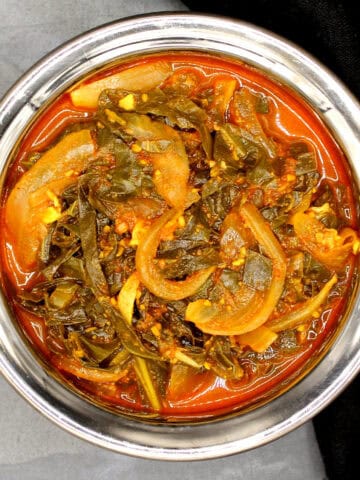
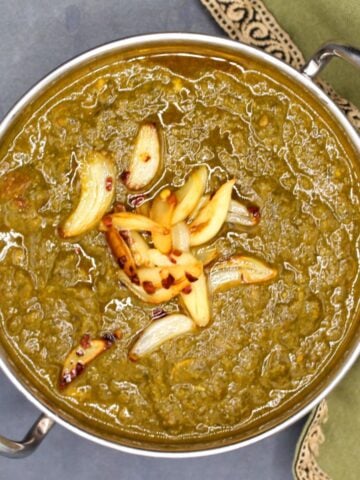
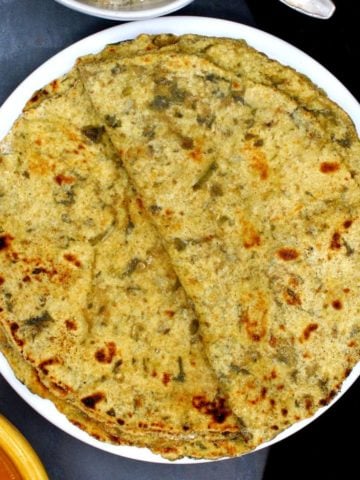
More Indian recipes with leafy greens


Recipe card

Malabar Spinach Curry Recipe
Equipment you'll need
- Pressure cooker (optional)
- Large saucepan or saute pan
- Blender
- Small skillet
Ingredients
- 10 ounces Malabar spinach leaves (any tender stems are fine, but discard tougher, thicker stems because they are very fibrous. Chop finely).
- ¼ cup toor dal (arhar dal/tuvar dal or split pigeon peas)
- ¼ cup moong dal
- ½ teaspoon turmeric
- 2 teaspoons avocado oil or any neutral oil (divided)
- 1 small red onion (sliced)
- 2 tablespoons coriander seeds
- 2 dried red chilli peppers (like Byadgi/Kashmiri/arbol, Use one if sensitive to heat and deseed)
- ½ cup shredded coconut (unsweetened. Can sub with 1 cup canned coconut milk)
- ¼ cup raw peanuts
- 1 teaspoon jaggery (or sugar)
- Salt to taste
- 1 teaspoon mustard seeds
- 8-10 cloves garlic (thinly sliced)
Instructions
Cook the dal
- Place the toor dal and moong dal in a pressure cooker or Instant Pot liner or saucepan. Add turmeric and enough water to cover by an inch.
- Stir in the chopped Malabar spinach leaves and pressure cook for three whistles, or for 10 minutes in the Instant Pot on high pressure. If cooking the dals in a saucepan, let the lentils come to a boil, then reduce heat to a simmer and cook until the dals are very soft and break easily.
Make the coconut paste
- In a pot or saute pan heat a teaspoon of oil. Add the coriander seeds, onions and red chilli peppers. Saute until the onions begin to change color. Remove to a plate and let the mixture cool a bit.
- Place the roasted onions, coriander and chilli peppers in a blender jar with grated coconut (or coconut milk). Add ½ cup water and blend to a smooth paste.
Make the Malabar spinach curry
- Add the cooked dal and greens to the pot along with the blended coconut-onion masala and peanuts.
- Bring the curry to boil over medium heat, then turn down the heat, cover, and let it simmer 10 minutes. Stir in the sugar or jaggery and add salt to taste.
Make the garlic tadka
- In a small skillet, heat a teaspoon of oil over medium heat. Add mustard seeds and, when they sputter, add sliced garlic. Fry until the garlic gets lightly golden. Turn off heat.
- Pour the tadka into the Malabar spinach curry and mix well. Turn off heat.



Madhur says
Gorgeous dal. One of my favorite recipes yet.
Vaishali Honawar says
So happy to hear, Madhur!
Rita says
Looks delicious! I have spotted Malabar spinach at the Asian store and hope to try soon. Thanks for the recipe.
Vaishali Honawar says
Hope you try! One of my favorites for sure. ❤️