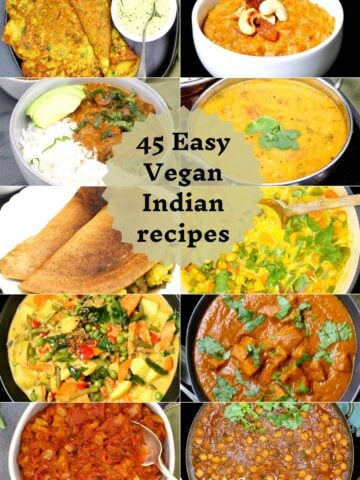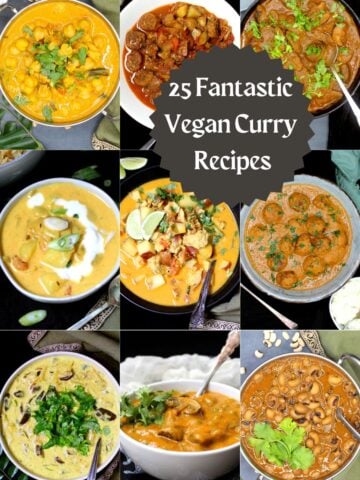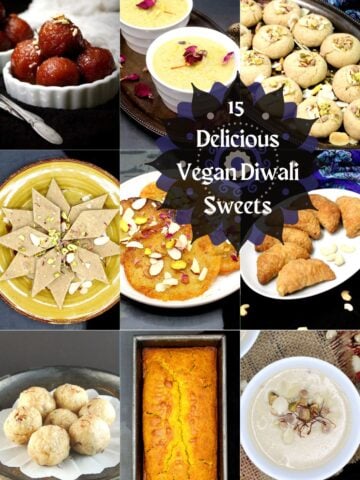
Welcome to your all-in-one guide for making delicious vegan Indian food at home. Whether you are a new cook or a seasoned pro who has been cooking curries for years, I have collected on this page all the tips, techniques, essentials and recipes you will need to cook meatless and dairy-free Indian meals that will wow your family and friends.
Use the table of contents below to jump to the section you are looking for, or grab a cup of chai and browse. I'll be updating this page with new content and recipes so be sure to check in often! And visit this page for a deeper dive into veganizing Indian recipes for authentic flavor.

Jump To
What is vegan Indian food?
Vegan Indian food is a modern take on Indian cuisine - or rather the many cuisines of India. It celebrates key ingredients used by Indian cooks, like grains, legumes, vegetables, fruits and spice blends, but excludes all animal-based ingredients, including meat, dairy products like ghee, yogurt, milk, butter and cream, and honey.
Staples of Indian regional cuisines
Learning how to veganize Indian recipes without sacrificing flavor requires a basic understanding of India's regional cuisines and their nuances; it's not just about adding garam masala and coconut milk to a dish and calling it a day. Regional Indian cuisines are very distinct from each other, and like all cuisines around the world, they have developed using whatever was local and easily grown. Here's a brief and very broad primer on the diets of people in the north, south, east and west of India.
North Indian staples: Most north Indian states are landlocked but parts of this region are extremely fertile and prolific growers of crops like wheat, rice, chickpeas, kidney beans (rajma) and a variety of vegetables. The Punjab region is also known for being one of India's leading milk producers and dairy products like milk, ghee, butter, buttermilk, paneer and cream are frequently used in every day cooking.
Vegan north Indian recipes to try: Vegan butter chicken, vegan naan, rajma, chana masala and tandoori tofu.
South Indian staples: Four of India's five southern states have long coastlines, and coconut, rice and spices grow abundantly here. These ingredients feature prominently in the local cuisine. Kerala is known for its seafood dishes, Andhra Pradesh for its rich, nawabi cuisine, Tamil Nadu for its vegetarian and spicy Chettinad cuisine, and Karnataka for its rich, spicy, tangy dishes like bisi bele bath.
Vegan south Indian recipes to try: Chettinad mushroom masala, ven pongal, vegetable korma, avial, bagara baingan and dosa.
Eastern Indian staples: Eastern Indian states like West Bengal and Odisha are on the Bay of Bengal and have an abundance of rivers. Seafood is extremely popular, as are ingredients like mustard, lentils and a variety of vegetables. In the extremely cold northeastern and Himalayan states of India, like Assam and Meghalaya, locals rely heavily on meat and fermented foods.
Vegan eastern Indian recipes to try: Cholar dal, aloo posto, chaunsa dal and Bengali dal with panch phoron.
Western Indian staples: Coastal regions of western India that border the Arabian Sea, like Maharashtra, typically consume a lot of seafood. In the desert state of Rajasthan, which has bitterly cold winters, the diet is fat-heavy with lots of wheat, millets and pulses. The cuisine of states like Goa was heavily influenced by Portuguese colonizers.
Vegan western Indian recipes to try: Dalitoy, vegetable vindaloo, dal dhokli, mango curry and masale bhath.
How to make authentic tasting Indian vegan dishes
When veganizing an Indian recipe, substitute the non-vegan or non-vegetarian ingredients with vegan ingredients that are as close to the original ingredients in taste and texture. When I first began blogging about vegan Indian food in 2007, I discovered that cashew cream was the best substitute for cream in north Indian dishes, not coconut milk. That's because coconut milk has a strong flavor of its own that overwhelms the tastebuds. If you use it as a cream substitute in vegan butter chicken, for instance, you won't taste the delicate spices and layers of flavor in the dish; the primary flavor will be coconut. I also found that replacing tofu for paneer in recipes like tofu palak paneer worked very well. While tofu doesn't have the richness and mouth feel of paneer, it has a similar look and also absorbs flavors in curries nicely.
You can read more about the exact substitutes to use in meat- and dairy-based Indian dishes in my comprehensive guide to veganizing Indian recipes.
Vegan Indian pantry staples
- Pulses: toor dal, masoor dal, chana dal, urad dal, chickpeas (kabuli chana), kidney beans (rajma) and black-eyed peas (lobhia). Chickpea flour (besan) is also a key ingredient. Learn more about legumes used commonly in Indian food, their flavors and their uses, in my complete guide to Indian pulses.
- Grains: rice (brown rice or white rice), atta (durum wheat flour, for making rotis and whole wheat naan), millets like jowar and bajra.
- Spices and spice blends: Garam masala, curry powder, sambar masala, biryani masala, turmeric, kasoori methi, cayenne or any red chilli powder, green cardamom pods, cloves, black peppercorns, bay leaves, cinnamon sticks, asafetida, cumin seeds, coriander seeds and mustard seeds. You can find all my Indian spice mix recipes here and check out this complete guide to Indian spices to learn more about the different spices used in Indian cooking, and how to use them.
- Nuts/seeds: Raw cashews (for vegan Indian sweets and as a substitute for cream), pumpkin seeds (if allergic to nuts). Coconut milk and coconut, although not nuts, are essential for south Indian vegan cuisine.
- Dairy alternatives: vegan butter, tofu and nut milks.
- Oils: Unflavored neutral oils, like avocado oil, sunflower oil, peanut oil and canola oil.
Here's a printable Indian vegan grocery shopping list.

Core techniques for adding flavor to vegan Indian foods

Tadka (tempering): This is a key step that happens either at the very beginning or at the very end of a dal or curry recipe. It involves adding spices to very hot oil so they "bloom" and release their aromas. When the oil is mixed into the dish, it flavors the rest of the dish, like this dal tadka. Tadka is a very common technique used by cooks around all of India and it can be particularly useful for adding another layer of flavor to vegan dishes.
Dum (slow cooking): Dum is the process of slow-cooking food in a sealed pot over low heat. This technique is widely used to make biryanis. The sealed ingredients release their aromas and, with nowhere else to go, infuse into each other. Dum produces particularly delicious dishes like vegetable biryani and dum aloo biryani.
Talna (deep-frying): Many of the most delicious, appetizing popular vegan foods in Indian cuisine are deep-fried. Think samosas, pakoras and pooris. When deep-frying Indian foods, maintain frying temperature between 350 degrees and 375 degrees Fahrenheit (180 to 190 degrees Celsius) to ensure the food absorbs as little oil as possible.
Simmering: This is how you'd cook most dals and curries, by simmering them until the ingredients are thoroughly cooked. Many Indian recipes will ask you to simmer curries "until the oil separates." That's the point where you see little droplets of oil collect on top of the liquid and it's an indicator that all the ingredients are now cooked. A great example of how this technique can be particularly useful in Indian vegan cooking is this mushroom curry, where the spices have to be simmered to perfection for the best flavor.
Sautéing (bhunana): Sautéing is one of the most important flavor-building techniques in Indian cooking. Many recipes begin by sautéing onions and/or tomatoes with ginger and garlic and, sometimes, spices. How long you sauté ingredients determines the final flavor and consistency of the dish. For example, onions that are sautéed until translucent will melt into the dish (e.g. vegetable korma), while onions that are browned will add rich flavor (e.g. mushroom masala). Tomatoes that are cooked until they darken will add depth (e.g. zucchini kofta curry) and tomatoes that are cooked just until pulpy will add sweetness (e.g. baingan bharta).
Layering: Layering flavors is a common technique in Indian cooking but it is particularly useful for adding flavor to Indian vegan recipes. I like using "hidden" layers of flavor like mushroom stock and tomato paste (for umami), mixing spice blends and slow-simmering ingredients in one-pot (like this Indian curry with mince).
Beginner-friendly Indian vegan recipes
Breakfast dishes

- Besan chilla (a vegan "omelet" made with chickpea flour)
- Upma (a savory pudding made with spiced sooji farina and vegetables)
- Poha (flattened rice with peanuts and potatoes)
- Idli (fermented rice and lentil cakes eaten with coconut chutney and sambar)
More Indian breakfast recipes.
Dals

Dals are eaten in homes all across India every day. These legume-based dishes are nutritious, filling, easy to make, and, when combined with grains, they make a whole protein. Here are some easy dal recipes to try at home:
- Yellow dal (my favorite recipe)
- Urad dal (spicy and flavorful)
- Whole masoor dal (rich, deep and delicious)
- Dal palak (fresh, nourishing, restaurant-style)
Find all of my vegan Indian dal recipes here.
Curries

There's a tendency, especially among the British, to club all Indian cuisine as "curry" but in India a curry is a very specific preparation: a stew-like dish with meat or vegetables. In the south of India, curries can be dry, like a sabzi. Here are some tasty curry recipes that are also beginner-friendly.
- Vegetable curry (creamy, with coconut milk and chickpeas)
- Tofu curry (easy recipe with cubes of tofu in a tomato onion sauce)
- Vegan "chicken" curry (full-flavored, great for omnivore palates)
- Chickpea curry (south Indian style with a delicious spice mix)
More curry recipes
Sabzi (vegetable sides)

A typical Indian dinner plate is made up of a grain like rice or roti, a dal or curry, and a vegetable side, called a sabzi. Indian vegetable sides are more often than not cooked, and flavored with spices. Here are some easy vegan sabzis to try:
- Cabbage curry (easy, sauteed cabbage side dish)
- Kashmiri haak (collard greens in a brick-red sauce)
- Bhindi masala (tender okra in a tomato onion sauce)
- Baingan masala (slivers of eggplant in a spicy sauce)
Indian breads

Regional Indian cooks use wheat and rice to make flatbreads. Yeasted breads are not as commonly eaten for lunch or dinner, with some exceptions. Learning how to make Indian flatbreads takes some time and patience, but most breads use simple pantry ingredients and are actually quite easy to master.
- Roti (a simple whole wheat flatbread eaten every day in many Indian homes)
- Paratha (a layered flatbread made with white flour for dipping into spicy curries)
- Vegan naan (a restaurant-style, puffy and yeasted wheat bread)
- Aloo paratha (a spicy potato filling stuffed into a whole wheat bread. This is often eaten for breakfast in north India.
- Pav (a yeasted bread roll eaten most often in Goa and Bombay, with spicy curries or in street food snacks).
More Indian breads
Rice dishes

Rice is the staple grain eaten across many parts of India, and you'll find a plethora of Indian rice dishes, ranging from simple, steamed rice to eat with dal to more complex rice dishes like biryanis and pulaos. If you are new to cooking Indian food, start with a simple rice dish like one of these:
- Basmati rice (plain, steamed or boiled rice to eat with dals and curries)
- Jeera rice (easy, cumin-scented rice)
- Turmeric rice (flavored with fresh or powdered turmeric and other spices)
- Lemon rice (rice with lemon, lentils, and peanuts)
More rice recipes
Desserts

Indian desserts are largely milk-based and contain copious amounts of ghee, making them quite unsuitable to a vegan diet. I have many vegan versions of favorite Indian sweets recipes on the blog. Some have a learning curve, but others are easy to master. I'd start with one of these:
- Vegan kheer (vegan Indian rice pudding)
- Vegan kaju katli (Indian cashew fudge)
- Sweet pongal (a south Indian pudding of lentils and rice)
- Vegan gajar ka halwa (a delicious carrot pudding)
More vegan Indian sweets
Sample vegan Indian meal ideas
Breakfast
- Mixed veg paratha with tomato chutney or lime pickle
- Upma with coconut chutney
- Sprouted moong chilla with onion chutney.
- Instant masala dosa (here's a gluten-free version)
- Sabudana khichdi (a savory, mouthwatering preparation with sago pearls and peanuts)
Lunch/Dinner
- Basmati rice with tomato dal and cabbage thoran
- Vegan curry with mince and vegan whole wheat naan
- Easy Vegetable curry with jeera rice
- Tofu paneer pulao with poppadum
- Vegetable biryani with vegan cucumber raita
- Goan "sausage" curry with pav bread roll
- Peas potato curry with roti
- Chana masala with poori or vegan grilled naan
- Vegetable korma with vegan naan
- Sambar with rice and green beans paruppu usili
Frequently asked questions about vegan Indian food
About 39 percent of Indians self-identify as lacto-vegetarians so no, a majority of Indians are not vegetarian. But most Indians who identify as non-vegetarians also follow a lacto-vegetarian or lacto-ovo-vegetarian diet most days of the week. The number of Indian vegans is a fraction compared to the vegetarians because the vegan movement is still quite new in India.
No. A lot of Indian restaurant dishes like dal might appear vegan on the face of it but they very likely have added dairy products like ghee, cream or butter for flavor. On my recent trips to south India I have discovered that restaurants now use ghee to make dishes that were once purely vegan, like dosa. Paneer, a homemade cottage cheese, is also used in many north Indian recipes. When in doubt, ask your server about the ingredients and ask for an alternative made without dairy products, if possible. If you are in India, don't use terms like "dairy products" when talking to the server. Ask specifically if the food contains ghee, malai (cream), doodh (milk) or makhan (butter).
Indian food is nearly synonymous with spicy food in the west, but the reality lies somewhere in between. While most Indian dishes incorporate spices, these are not always "hot" spices - the ones that set your mouth on fire, like black peppercorns and chili peppers. Most spices, like cloves, cardamom, cinnamon and bay leaves, add flavor, not heat, to a recipe. When cooking Indian food, always feel free to tweak the quantity of chili pepper to your taste or leave it out.
I get this question very often and the answer is an unequivocal no. I believe that the reason this myth has spread through countries outside India is because south Indian restaurants, both in India and outside it, tend to serve vegetarian food, while north Indian restaurants specialize in Mughlai cuisine, which has many non-vegetarian offerings. This is simply a supply and demand issue: Indians who identify as non-vegetarian often choose vegetarian meals when eating outside, a concern that had more to do with affordability, hygiene and the "cleanliness" of animal foods prepared in a restaurant kitchen.
Another reason why south Indian cuisine is perceived as more vegetarian friendly could be socio-economic. South Indian migrants outnumber migrants from other parts of India, particularly in recent years, and south Indian brahmins, who are traditionally vegetarian and who have historically been more affluent because of India's oppressive caste system, are disproportionately represented in the Indian diaspora.
Finally, here are some vegan Indian recipe collections that I've put together for you. Happy browsing!