

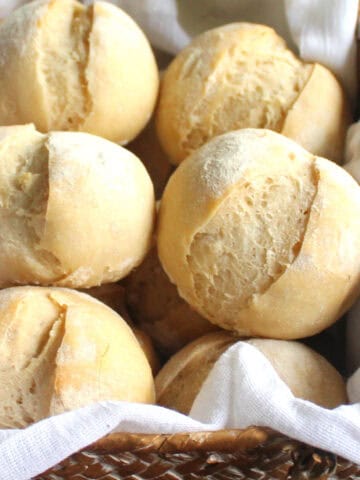
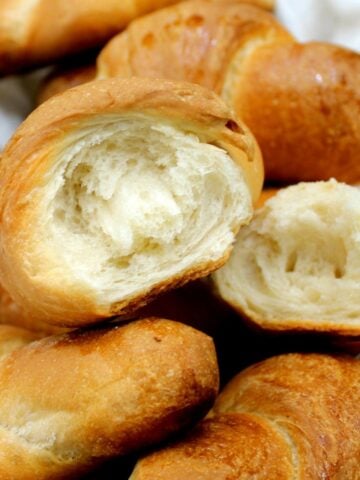
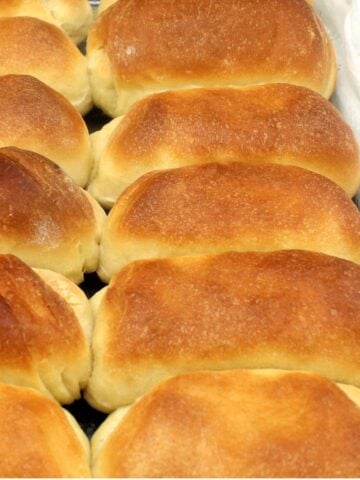
These pav rolls are soft and fluffy - perfect to serve with Indian street food favorites like pav bhaji, misal pav and vada pav. You can also dunk them into spicy curries, tea or coffee!

What is pav?
Indian cuisine is most often associated with flatbreads like roti, naan and paratha. But in former Portuguese colonies like Bombay and Goa, a humble dinner roll, pav, gained a foothold and entrenched itself into the local food scene.
Pav (also spelled "pao"), is a very basic bread, made with just yeast, flour and water or milk. It is also eggless - a nod to the many Indian lacto-vegetarians who do not eat eggs. In Bombay, where I grew up, it was always sold in slabs or four, six, eight, 10 or 12 and it went by the sobriquet of "laadi pav" with "laadi" meaning slab.
Pav is usually available in two varieties: a soft pav, like this one, and a pav with a harder crust called "brun pav" or "kadak pav." The only difference between the two is that the latter is baked in a steamy oven to create a crustier crust (like French bread). If you ever happen to be in Bombay, visit one of its charming but dwindling Irani restaurants and order a plate of "brun maska" made by slashing a brun pav in half and slathering it with butter and jam: it's a rare and delicious treat.
In our home we'd typically eat pav by dipping it into a spicy curry but just as often we ate it for breakfast, dipped in tea. You could still feel the warmth of the bakery oven on your fingers when you tore the pav open - a comforting treat, if there ever was one. Later, when I'd visit my dad in Goa, I'd look forward to seeing the poder (from the Portuguese word for baker, padeiro) who would make the rounds of neighborhoods every morning, a big basket of fresh-baked pav balanced on his bicycle, honking the horn to alert residents that breakfast is here!
Vegan pav
In bakeries, pav is typically made with just flour, water and yeast. But to get the correct texture in a home kitchen, milk is added to the recipe. The milk helps make the rolls softer and fluffier. For this vegan pao recipe soy milk works wonderfully because it has a higher protein content, like milk.
I shared this pav recipe many, many years ago in my pav bhaji recipe, and I've continued to make it over the years without many tweaks because it's quite perfect as it is. The only variation I do make is to sometimes use whole grain flour (more on that below).
Recipe card

Pav recipe
Equipment you'll need
- Large bowl or stand mixer
- 8 X 8 inch baking dish
Ingredients
- 3 cups all-purpose flour
- 1 ½ teaspoon active dry yeast
- 2 teaspoon sugar
- 1 teaspoon salt
- 1 to 1 ¼ cups soymilk (lukewarm. If soy-free, use pea milk or any non-dairy milk)
- 2 tablespoons avocado oil or any neutral oil (or vegan butter at room temperature)
Instructions
- Place all dry ingredients in a large bowl or in the bowl of a stand mixer: yeast, flour, sugar and salt.
- Knead on medium-low speed in a stand mixer or by hand for about 3 minutes, trickling in enough milk until you have a dough that's smooth but slightly sticky.
- Add the oil and continue to knead until the oil has been absorbed by the dough. This might take a couple of minutes.
- Shape the dough into a smooth ball and place it in an oiled bowl, turning over once to coat the top with oil. Cover with cling wrap or a tight lid and set aside to proof in a warm spot until the dough has doubled or more.
- Knead the dough slightly and divide into 12 equal-sized balls. Pull down the edges and tuck them under to form round or oval rolls.
- Nestle the rolls in an oiled, 8 X 8 inch baking dish. Cover with cling wrap or a kitchen towel and set aside in a warm spot to rise for an hour.
- Preheat the oven to 370 degrees F/190 degrees C.
- Place the risen pav rolls in the oven and bake 22 minutes until golden brown. Cool thoroughly on a wire rack.
Notes
Nutrition Information
How to make pav

Place all dry ingredients in bowl: yeast, flour, salt and sugar.

Trickle the milk into the dry ingredients, while kneading in a stand mixer or with your hands, until you have a smooth, supple, stretchy dough. This should take about five minutes of kneading. Add the oil and continue to knead the dough until the oil has been completely absorbed by the dough.

Form the dough into a ball and place in an oiled bowl, making sure you coat the top with some oil as well to keep it from drying. Cover with cling wrap or a tight lid, place in a warm spot, and let the dough rise for two hours.

By the end of two hours the dough should have more than doubled. Knead it slightly and divide into 12 equal-sized balls. Pull down the edges and tuck them under to form round rolls.

Nestle the rolls in an oiled, 8 X 8 glass baking dish. Cover with cling wrap or a kitchen towel and set aside in a warm spot to rise for an hour.

Preheat the oven to 370 degrees Fahrenheit/190 degrees Celsius. Place the risen rolls in the oven and bake 22 minutes, until the rolls are golden-brown. Cool thoroughly on a wire rack.

Pav FAQs
Yes. To make a part-whole-wheat pav use a 50:50 proportion of all-purpose flour and whole wheat flour. It creates a nuttier-tasting, more dense but fluffy pav that's also healthier. For an all-whole-wheat pav substitute the all-purpose flour with whole wheat flour and replace 1 tablespoon of the flour with vital wheat gluten for a soft texture and good rise
Pav is most famously used in Bombay street food recipes like pav bhaji, vada pav and misal pav. But I also love it to sponge up curries like this spicy mushroom curry or vegan chicken curry. Or do as the Irani restaurants do and serve it as a snack: cut a roll across, daub on a good amount of vegan butter, and top it with jam. Yum!
Yes. Soy milk does improve the texture of the bread but if you can't eat soy or don't have soy milk, use any other non-dairy milk.



Adri says
Hi!
Do you think this recipe would work with GF flour, such as sorghum or millet? If so, what would be best to replace the gluten with?
Many thanks 🙏🏻
Adri
Vaishali says
Hi Adri, I haven’t made this with gf flour but it might work. I’d use an all purpose gf flour with some xanthan gum added.