

Learn how to make lacy and delightfully crispy rava dosa at home with my simple recipe. It comes together in minutes and I will walk you through every potential pitfall so you can be flipping tasty rava dosas in no time at all!

Jump To
What is rava dosa?
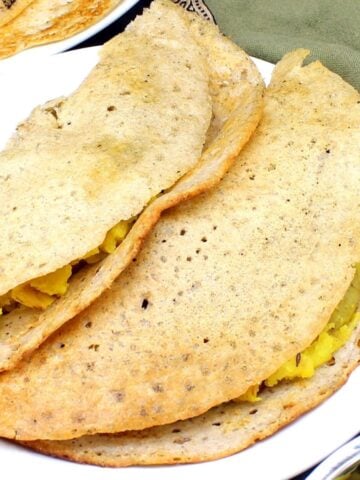
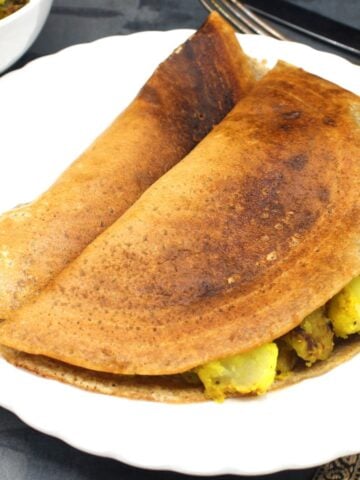
Rava dosa is a thin and crispy south Indian crepe made with a quick batter of rava or sooji, wheat flour, rice flour and seasonings like cumin seeds, green chili peppers and onions.
Unlike a traditional dosa batter, which involves a day-long process of soaking rice and lentils, blending and then fermenting them, a rava dosa batter can be assembled in minutes and it needs to stand just 30 minutes before you begin making dosas. This makes it an easy choice when you want dosa right now and simply don't have the patience to wait until tomorrow.
But what makes a rava dosa special and certifiably craveable is it's texture. While a traditional dosa is soft and spongy, a perfectly made rava dosa is thin, divinely crunchy, with large holes that give it a lace-like appearance. It is truly a one-of-a-kind treat.
So far so good. But mastering the perfect rava dosa recipe at home can be tricky. There are two reasons for this:
- Rava dosa batter is ridiculously watery. It needs to be that way to create those large, lacy air holes for that delicious crunch. Learning how to make a rava dosa batter with the perfect consistency can be difficult: too much water and the dosa won't set up; too little water and it won't be crispy.
- Unlike a traditional dosa batter, which is evenly spread on a griddle, a rava dosa batter has to be poured onto the screaming-hot griddle in a quick motion from some height. When the batter splashes against the griddle, it creates those large air holes. It will take some experience to learn to do this right.
But fear not, because I have done all the hard work for you. It took me many attempts to master the perfect, restaurant-style rava dosa but this recipe I am sharing with you today is one I am truly proud of. It has the perfect proportions of water, sooji and flour and it's quite foolproof. Thanks to all those mistakes I made, I can share with you my best tips so your own learning curve can be much smaller.
Love south Indian dosas? I have so many delicious and healthy dosa recipes for you, including adai, sorghum dosa, quinoa dosa and brown rice dosa.
How to make rava dosa
Make the rava dosa batter
- Place all of the batter ingredients in a bowl- the rava, all-purpose flour and rice flour. Add the seasonings, including chopped curry leaves, onions, grated ginger, green chili peppers, cumin seeds and salt. Mix everything together.

- Add four cups water to the bowl and whisk to mix. Don't worry that this is too much water, you need it. Set the batter aside for 30 minutes. It's okay if you see some small lumps in the batter, they will dissolve while the batter stands. After 30 minutes, add one more cup of water to the bowl and whisk again to mix everything. You will need to mix the batter thoroughly each time you scoop it out to make dosa.

Make rava dosa
- Heat a non-stick or cast iron griddle over medium-high heat. Brush on a thin coat of oil. When the oil begins to smoke, reduce heat to medium. Stir the batter one more time and use a rounded soup ladle to pour the rava dosa batter on the hot griddle from a height of about two to three inches. The batter should spread immediately on its own, forming holes. Pour more batter around it (not over it), if needed, to create a more even shaped dosa. Rava dosa doesn't need to be perfectly round.
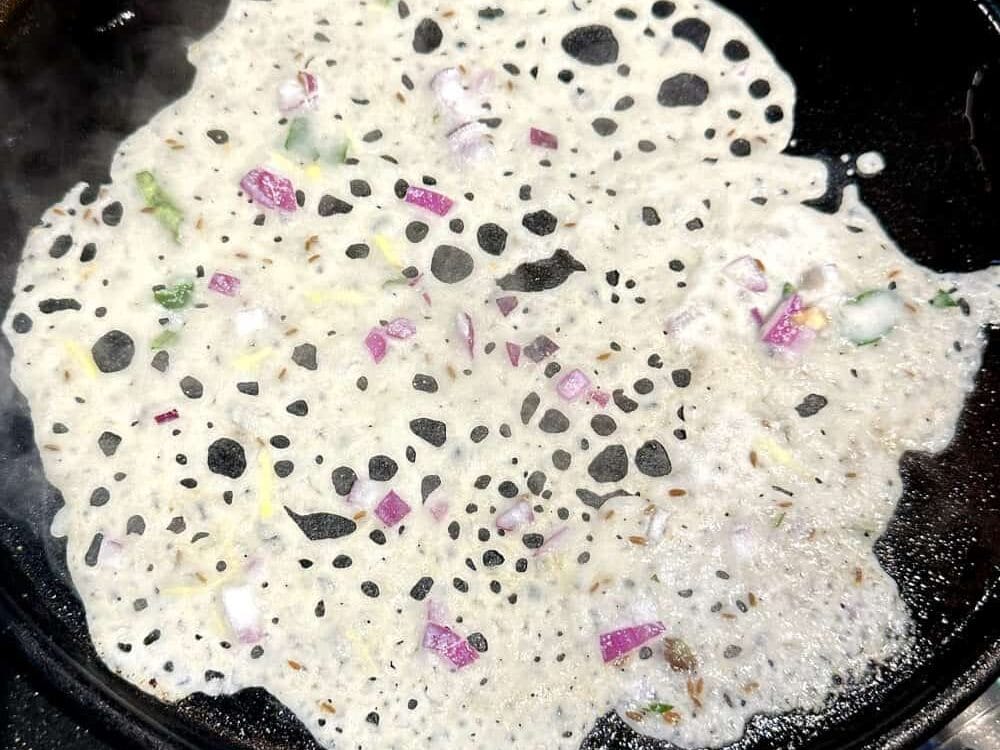
- Use a spoon to dribble a bit of oil around the edges of the dosa and into the larger holes. This will help the dosa crisp up. Don't touch the dosa until the edges and the areas around the holes begin to look very golden brown (like in the photo below). At this point use a thin spatula to gently loosen the dosa at the edges, moving gradually to the center.
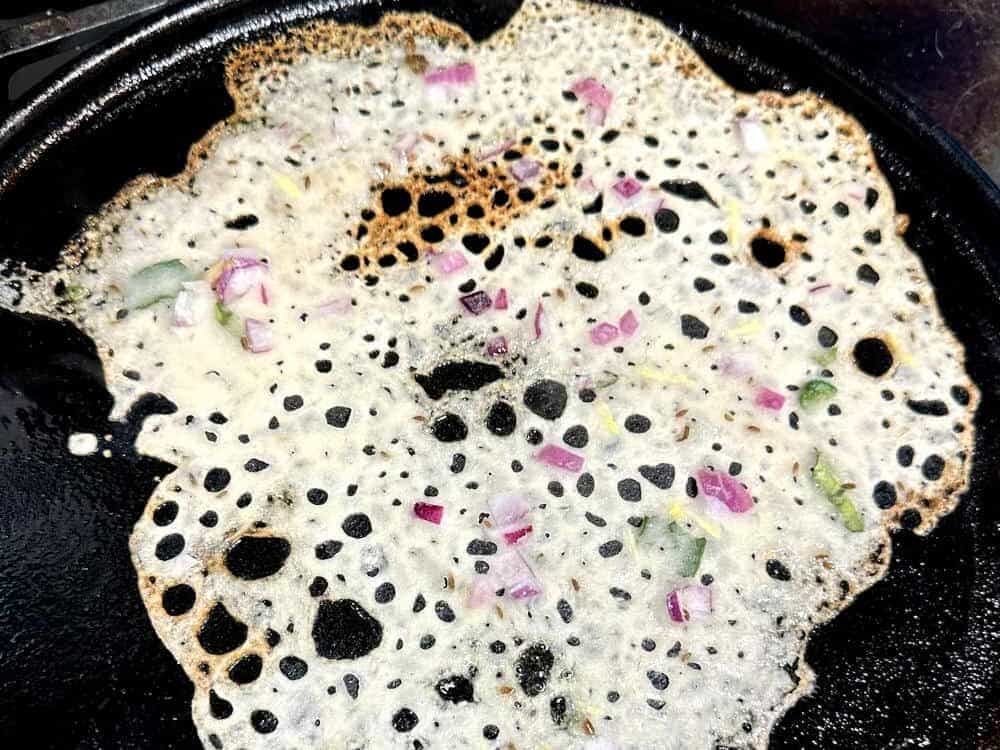
- Place some potato masala over one half of the rava dosa. If you're not adding the potato masala you can skip this step and remove the dosa to a plate.
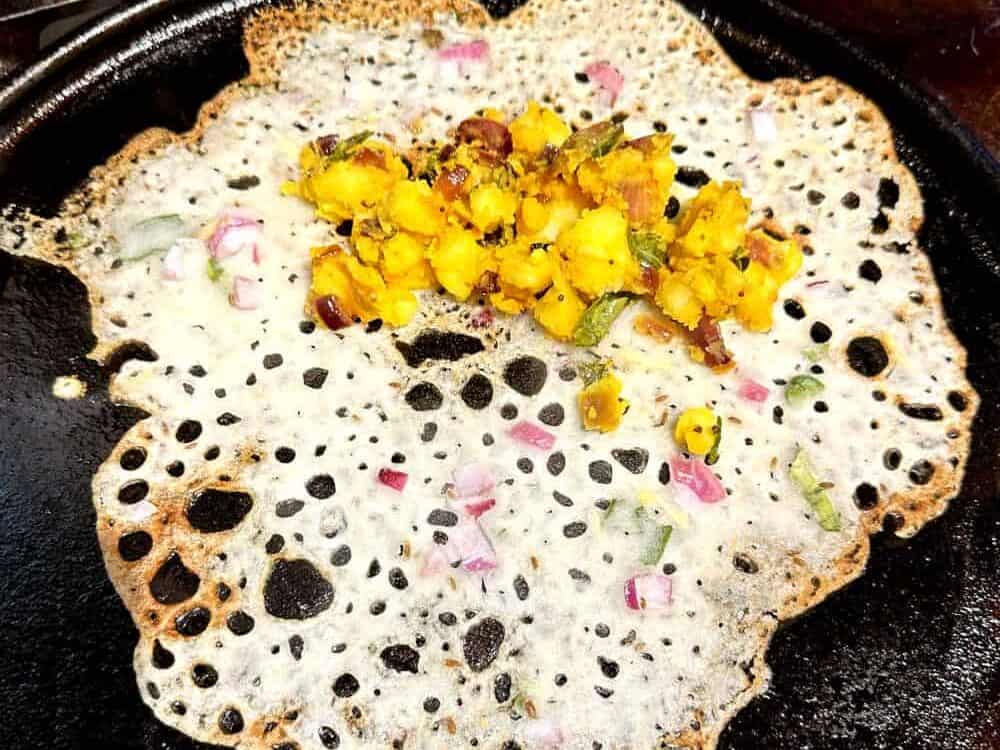
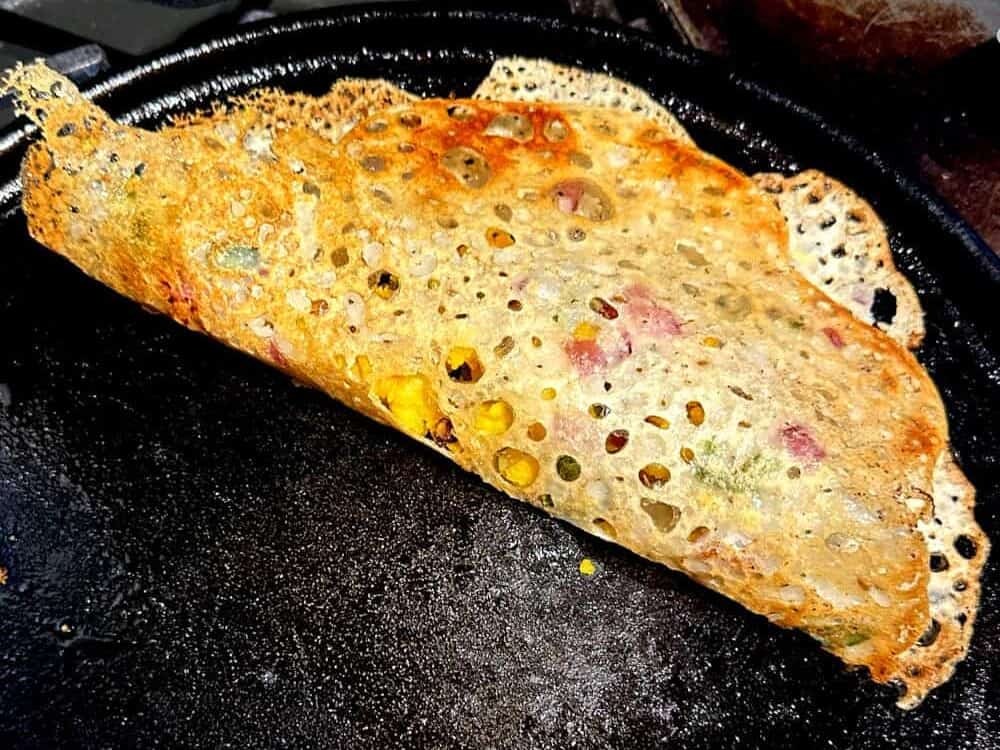
- Fold the dosa over the potato masala. Gently lift it off the griddle and serve immediately.
Recipe card

Rava Dosa Recipe
Equipment you'll need
- Large bowl
- Non-stick or cast iron griddle (tava)
Ingredients
- 1 cup rava or sooji (finely ground)
- ¾ cup all-purpose flour (maida)
- ¾ cup rice flour
- 2 sprigs curry leaves (chopped. You can substitute these with 2 tablespoons of cilantro)
- 1 medium red onion (finely chopped)
- 1 tablespoon ginger (grated)
- 1 green chili pepper (like jalapeno or serrano, minced)
- 1 teaspoon cumin seeds
- Salt to taste
- 5 cups water (divided)
- ¼ cup avocado oil or any neutral oil (or cooking spray)
For serving
- Potato masala
- Coconut chutney
Instructions
Make the rava dosa batter
- Place the rava, all-purpose flour and rice flour in a large bowl. Add chopped curry leaves, onions, grated ginger, chopped green chili peppers, cumin seeds and salt.
- Add four cups of water to the bowl and whisk. Don't worry about small lumps. Set the batter aside for 30 minutes. Whisk the batter (any lumps would have smoothed out by now). Add the remaining cup of water and whisk to mix.
Make rava dosa
- Heat a non-stick or cast iron griddle over medium-high heat. Brush on a thin coat of oil. When the oil begins to smoke, reduce heat to medium. Stir the batter thoroughly one more time and use a rounded soup ladle to pour the rava dosa batter on the hot griddle from a height of about two inches. The batter should spread immediately on its own, forming holes. Pour more batter around it (not over it), if needed, to create a more even shaped dosa. Rava dosa doesn't need to be perfectly round.
- Use a spoon to dribble a bit of oil around the edges of the dosa and into the larger holes. This will help the dosa crisp up. Don't touch the dosa until the edges and the areas around the holes begin to look very golden brown (like in the photo above). At this point use a thin spatula to gently loosen the dosa at the edges, moving gradually to the center.
- Place a few tablespoons of potato masala, if using, over one half of the dosa. Fold the dosa over the potato masala. Gently lift it off the griddle and serve immediately.
- Continue to make more dosas, stirring the batter well each time before scooping it out on the griddle.
Notes
Ingredient notes
- Rava (also called sooji or semolina). This is ground wheat, but it's not a flour. You can find rava/sooji at any Indian store or online and it is sold both in a coarse grind and a fine grind. For this recipe, and for recipes like vegan sooji halwa, rava idli and rava upma, you need fine-ground rava.
- All-purpose flour (maida). Flour provides the binding prowess that's needed to keep the dosa together and to help it set up.
- Rice flour. The rice flour helps make the rava dosa crispy and also helps with structure.
- Onions. Finely chopped onions are divine in a rava dosa. When cooking Indian food, red onions or shallots are preferred, but if yellow or white onions are what you have they will do. A rava dosa made with onions is called an onion rava dosa. You can skip the onions for a plain rava dosa.
- Curry leaves. You can substitute cilantro for the curry leaves.
- Green chili peppers. Use jalapeno or serrano chillies or any green chilli peppers you can get your hands on. Deseed the chilies for less heat. If very sensitive to heat, use fresh-ground black pepper instead.
- Potato masala. This is the stuffing that goes inside the rava dosa. You can also serve the rava dosa plain with some chutney.
Nutrition Information

Recipe FAQs
You can eat rava dosa for breakfast, lunch, dinner or for a snack. I usually serve it for weekend breakfast.
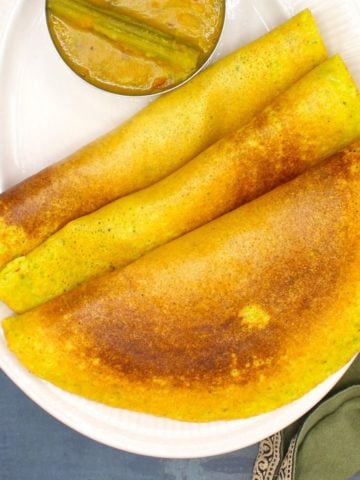
Serve it with or without the potato masala stuffing. For dipping, serve coconut chutney, onion chutney or tomato chutney and/or sambar.
Letting the batter rest gives the rava or sooji a chance to absorb water and fluff up. If you make the dosa right after you have mixed the flours and water, without giving the rava time to soak, the rava will still be gritty and the dosa won't set up as well.
Are you making sure you mix the batter thoroughly each time you take a ladleful to make dosa? Because there is so much water in this batter the solids tend to easily settle down at the bottom. It is imperative to stir the batter every time before you make the dosa. Another reason could be that you are holding the ladle too close to the griddle when you pour the batter. Pour from a height of at least two to three inches and do it in a quick motion so the batter splashes off the griddle slightly, creating air holes.
No, because whole wheat flour won't provide enough structure to help the dosa hold together.
Oil helps give the masala dosa its signature crispy texture. If you want to avoid oil altogether be prepared for softer crepes and make the rava dosa in a nonstick griddle. If possible use cooking spray.
Use a flat non-stick griddle or well-seasoned cast iron griddle to make rava dosa. In India, use a cast-iron tawa or tava. Cast iron creates the crispiest dosa.
Dosa of any type is not ideal for storing and rava dosa will lose its crisp texture after standing for more than a few minutes. Always serve dosa hot off the griddle. You can store the batter in the fridge overnight but this can also alter the texture of the dosa because the rava will continue to absorb water.



Camilla says
This was the best rava dosa recipe I have made and I have tried quite a few. Your instructions were so easy to follow. Thank you for this easy breakfast. Will make again.
Vaishali Honawar says
So happy to hear Camilla!