

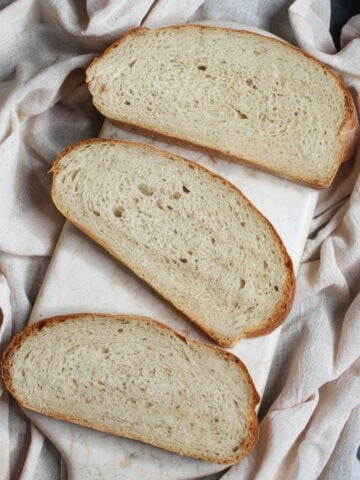
Soft, fluffy and feathery, with no eggs! This whole wheat challah bread was one of the first bread recipes I veganized and it's since been a go-to, not just for dinner but also for making French toast, sandwiches and puddings.

Jump To
A healthier vegan challah bread
Challah is one of my favorite breads. This popular Jewish bread is flaky like a brioche, with a gorgeous, braided look that's easily achieved even by someone as certifiably un-craftsy as I am. I have shared with you my vegan challah and vegan sourdough challah recipes. This whole wheat challah - the first bread recipe I ever posted on this blog back in March 2008 - preceded them all.
The reason I was so motivated to make a vegan challah - even before I became fully vegan - was because as much as I adored the texture of this bread, I was never a fan of the eggs. I could smell them a mile away. But eggs are key to that flaky challah texture and those of you who have made this recipe before might remember that I used flax eggs as a substitute in my original version.
As I learned more about baking bread, however, and - importantly - created vegan versions of Jewish breads like chocolate babka - I realized I didn't really need the flax eggs. I could get that flaky texture with a mix of bread flour and whole wheat flour, and by beating vegan butter (instead of oil) into the dough, like a brioche.
It's this new, improved and whole wheat vegan challah bread recipe I have for you today, and it tastes better than ever. This is a simple bread recipe, needing the standard two rises. It goes from scratch to done in about four hours.
I've shared with you so many tips for baking bread in my other bread recipes so I'll add just one here. Don't make the strands of dough for the braid too thin or the loaf will feel dry.
Now let's make some challah!
Recipe card

Vegan whole-wheat challah bread
Equipment you'll need
- Large bowl or stand mixer
- Baking sheet
Ingredients
- 2 ¼ teaspoon active dry yeast (or instant yeast)
- 3 tablespoons sugar
- 1¼ cup soy milk (or any non-dairy milk)
- 4 tablespoon vegan butter (soft, at room temperature)
- 1½ cups whole wheat flour
- 1½ cup bread flour
- ½ teaspoon salt
Instructions
Make the dough
- If using active dry yeast, mix the yeast, sugar and milk in a large bowl or bowl of a stand mixer. Let it stand five minutes until the yeast bubbles.

- Add the whole wheat flour, all purpose flour and salt to the bowl. Mix until all of the flour is moistened. It might look a little crumbly at this point, which is fine.
- Add the room temperature butter to the bowl and begin kneading it into the dough until the dough has absorbed all of it.
- Continue kneading for another five minutes. This is best done in a stand mixer; if you are kneading by hand you might need longer for the butter to be absorbed into the dough.


First proof
- Transfer the dough to an oiled bowl, turn it once to coat the top with oil, then cover tightly with a lid or plastic wrap. Place it in a warm spot in your kitchen for 1½ hours.
- The dough should have more than doubled by this time.


Braid the challah loaf
- Place the risen dough on a flat surface and gently deflate. Divide the dough into three equal portions. Form each of the portions into a rectangle, then roll it (like a jelly roll) into a cylinder.
- Use the palms of your hands to roll out each cylinder into a 15-inch long strand with tapered ends. If the dough resists, let it rest, covered, for five minutes, then roll. Place the three strands side by side and pinch the tops together to form a tight seal. Use a little water if needed to ensure they hold together.
- Braid the challah by passing the strand on the right over the center strand. Then take the stand on the left and pass it over the strand that is now in the center. Continue until the loaf is braided. Pinch the ends together before tucking them under the loaf.


Second proof
- Transfer the loaf to a baking sheet that has been oiled lightly or dusted with cornmeal. Cover the loaf loosely with a kitchen towel and set it aside to rise for another hour. The loaf should have doubled during this time and should be quite puffy.
Bake challah
- About 10 minutes before the loaf has fully risen, preheat the oven to 375 degrees Fahrenheit/190 degrees Celsius.
- Before putting the loaf in the oven, brush on a vegan "egg wash" made by mixing together a teaspoon of non-dairy milk and a teaspoon of olive oil. Brush it all over the top of the loaf. You can also sprinkle on some sesame seeds for a pretty look.
- Bake the challah bread for 30 minutes until golden brown. Remove the baking sheet to a wire rack and let it cool 30 minutes before transferring the loaf to the rack. Cool thoroughly before eating.


Nutrition Information

Recipe FAQs
You can, but the bread will be quite dense. To lighten it up you can add a tablespoon of vital wheat gluten.
Challah bread is traditionally made with oil because kosher dietary laws forbid mixing meat and dairy and a challah made with butter cannot be served with a meal that also includes meat. Vegan butter doesn't have any dairy in it (it is made with refined coconut oil). The vegan butter also adds the richness you forfeit by skipping eggs.
Divide the dough into four or five equal portions, roll and braid! You can find lots of great guides online, including this one, that guide you on forming complex, gorgeous shapes with challah dough.
First published March 11, 2008. Updated and re-published on Aug. 17, 2025.



Tracy Ross says
Could I use olive oil instead of vegan butter?
Vaishali says
Yes, absolutely.
Ruchama Burrell says
To use challah for Shabbat dinner or lunch one needs to have two loaves. You can make one larger and two smaller, then only cut into the larger on Friday, saving the two smaller (after one of them has been on the table with the larger loaf for the blessing) for lunch. You cannot just have a single loaf for either Shabbat meal if you are to satisfy the ritual requirements. I think this recipe, doubled, would work.
Vaishali says
Good to know! Thanks for sharing these insights.
JNNL says
Vaishali, Thank you for this recipe. It's actually hard to find vegan recipes for challah. I make challah for my husband, and GF challah for myself regularly, with recipes I've adapted/developed myself. I plan to try to make a GF version using your recipe and will let you know the outcome! Thank you!
Vaishali says
Would love to hear how it goes with gf flour!
Alex says
Could I substitute the flax for chai? Thank you
Alisa says
I have made this challah a few times for vegan friends and it is outstanding.
Alisa says
i made this challah and I must say, it really was incredible and a big hit with our vegan friends. It was soft and delicious. Will be saving this recipe for future vegan eaters.
Radhika says
Hi Vaishali, thanks for trying out stuff and sharing it for the whole world to enjoy. I tried out this recipe. Instead of bread flour, I used 1 cup all purpose flour plus 2tbsp vital wheat gluten. I guess I should have removed 2tbsp from the flour before adding this. I substituted whole wheat pastry flour with all purpose flour and used our 'atta' for whole wheat flour.
The challah was soft and delicious, though nowhere as picture perfect ad yours. It did not brown so much but passed the 'hollow sound when tapped' test and was cooked.
I tried filling it with chocolate and walnuts(the individual rolls of the braid) inspired by another site, but I felt that I could hardly taste the filling. Have to figure out how to improve that next time.
alli says
Thanks for writing!
Unfortunately all pre-made Gluten Free bread mixes contain RICE FLOUR and I’m allergic to rice…
I would love an oat flour based challah dough that would be fluffy and sweet and reminiscent of real challah.
And BTW..I’ve heard of and seen pictures online of vegan oat flour based gluten free challah dough that can be braided, but there are no recipes…
(check out challahluya.com and look for her vegan gluten free water based challah. It looks delish!
Everyone is hoarding their secrets..
>sigh<
Please develop one soon??
Thx!!
xo
ali says
Can you make a suggestion how we can make your vegan challah recipe Gluten Free as well..?
I am allergic to eggs and gluten, and am dying to have an awesome challah recipe. I haven't had any in years!
But have no idea what flour blend would work....( It has to contain oat flour though..) Or if the proportions of ingredients would change at all because of the swap out to gluten free flours..
If you could create a tasty yummy oat flour based vegan challah recipe for us gluten free and vegan peeps, your recipe would be made by tons of people and sooooo appreciated.
My attempts have been sucky. 🙂
Thank you!!!!
Vaishali Honawar says
Hi Ali, you might want to stick with a premixed gluten-free bread flour recipe to begin with. You won't be able to shape it into a braid, because gluten-free flour doughs are more of a batter, but you might get a decent. flaky bread.
I will try my hand at one, hopefully sooner rather than later. Thanks for your message! 🙂
Priya says
Hi Vaishali,
I was searching for vegan whole wheat challah and this recipe was on top of google search results. 🙂 Have one question, can I substitute flaxseed with applesauce or is there any other substitute for flaxseed? please let me know.
Thanks,Priya
Vaishali says
Hi Priya, yes, add 1/2 cup of applesauce. That should work just fine. Let me know how it turns out! 🙂
Anonymous says
This is my favorite bread! I have made it many times. Thank you for sharing!
Anonymous says
Can this dough be refrigerated overnight after the first rising? Should anything be modified in the recipe in order to do so? Thanks.
Vaishali says
Yes, you can, and then thaw it completely, shape, and let it rise again before baking.
Sarah says
I am a observant Jew and have been eating challah my whole life. I have been trying to go vegan for a while and this recipe has brought me one step closer. I have made this a few times and it has come out great each time! Thank you so much for sharing this.
Mar'ah says
I only just found your blog by doing a Google Search for Vegan Challah. I *heart* you so much for this! 🙂
AikoVenus says
Thank you so much! I thought that I would never be able to make something like this because challah is such an eggy bread.
Vaishali says
Scgilles, welcome! The oil is rather important for the texture, so I wouldn't recommend replacing it. You might try reducing it by a tablespoon or so, but if possible I'd still just go with the recommended amount-- it's not a lot considering it's a whole, rather big loaf of bread.
Scgilles says
I just found your blog tonight and I am so excited about trying a bunch of your recipes! I was thinking about trying the Challah bread but I needed to know if you thought I could replace or omit the oil. Thanks!
Martha says
SO DELICIOUS, but so much flour is unnecessary. With my last (big) loaf, I doubled it, but with the same amount of yeast, 4 TB oil, 4 TB sugar, and leaving out almost 2 cups of flour. Beware of dough that is too dry, it will not rise!
Anonymous says
Thank you so much for this recipe. I am new to being a vegan and am starting a new chapter in my life, in general. I appreciate you having created this recipe and sharing it. I will try it tomorrow.
-Karen
Vaishali says
Anonymous, I would reduce the whole wheat flour to half a cup and substitute the bread flour for 2 cups of all-purpose flour.
This is because all-purpose flour has more gluten than whole-wheat, but less than bread flour, so reducing the amount of whole wheat and increasing the amount of all-purpose flour balances out the gluten content. (Gluten is what gives your bread its structure). Does that make sense?
Anonymous says
Dear Vaishali
Is there any substitute for bread flour?
Thanks