

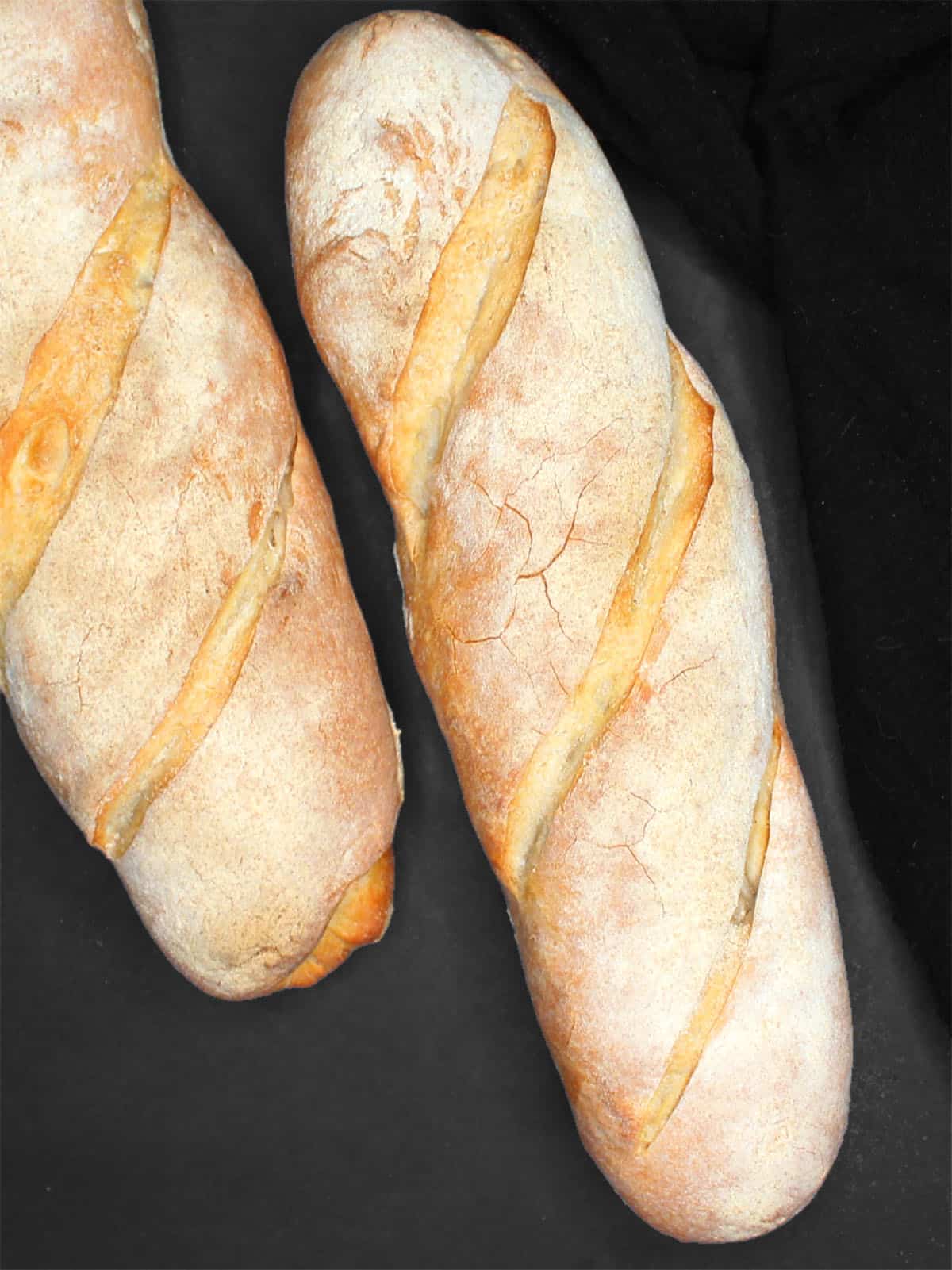
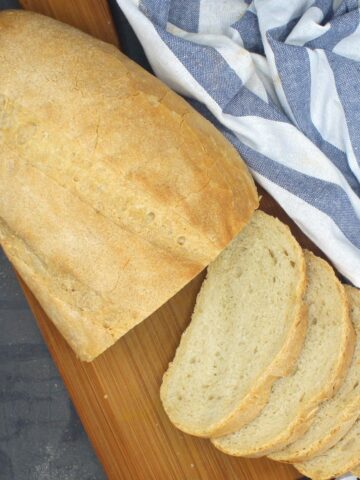
With this easy French bread recipe you can have fresh, homemade bread even on a weeknight. It has a soft, light crumb, a golden, crackly crust, and it's ready in two hours.
Jump To
The best French bread
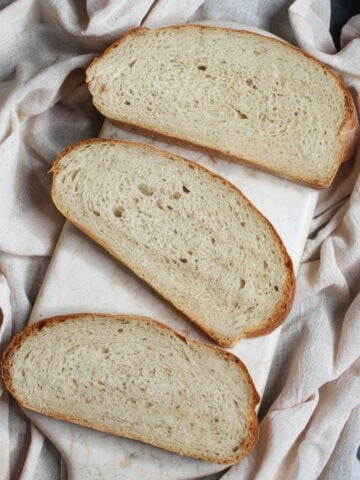
If you think baking French bread is intimidating, here's the perfect loaf to hone your skills on: it has a golden, crispy crust and a soft, fluffy crumb with a fantastic hole structure. It's so good, it'll make even the most seasoned baker proud. It's so quick, it'll flip even the most impatient among us who think making bread - real bread, real good bread - takes too much time. Best of all, it's so easy, especially with my step-by-step directions and photo guide below.
French bread is a minimalist bread. It needs just four basic ingredients - flour, yeast, salt and water - but what sets it apart is the high water content and the kneading and the folding of the dough to make those long, slender loaves. You will get better with practice but meanwhile, to make this bread foolproof without straying too far from authenticity, we'll add one or two other simple ingredients.
My top tips
- "Bloom" the yeast. Before using yeast that has been sitting around for a while, make sure it's still alive by giving the yeast time to "bloom" in lukewarm water. If it froths and bubbles in five minutes, it's active. If not, you need new yeast.
- Use a smidgen of vitamin C. This is optional and it sounds weird, I know, but it really makes the bread foolproof. I adopted this idea from the food scientist Shirley Corriher who adds a bit of vitamin C to her French bread recipe to help the yeast develop. I use ¼ of a teaspoon of Vitamin C powder, but you can also crush a 500 mg vitamin C tablet and use ¼ of it in this recipe.
- Knead the dough. French bread dough needs to be kneaded thoroughly so the gluten is activated, helping the bread rise beautifully. Once the dough has come together, I recommend kneading it for at least five more minutes, and up to eight minutes for best results. For a no-knead bread recipe, try no-knead sourdough bread or crusty sourdough rolls.
- Make the dough soft but not sticky. The dough for French bread should look a bit tacky after it's been kneaded (see photos below), but it shouldn't stick to your hands and you should easily be able to form it into a ball. Don't be tempted to add too much flour. A French bread needs a dough with a high water content that's soft, supple and can be easily shaped.
- Slash the risen loaves. Making a couple of gashes in the bread loaves after they've risen and before you bake them gives the gases released by the yeast a vent to escape. The gashes also puff out as the bread bakes, giving the bread an artisanal look. A bread lame (pronounced "lahm") is the best tool for slashing risen loaves but any sharp knife will work. The key is not to saw into the risen loaf but to make a sharp, swift cut, going at least a quarter inch to a half inch deep, with a single stroke. You will get better at this with practice.
- Dust the loaves with flour after shaping them. You need to cover the unbaked loaves as they rise. Dusting them with flour will keep the kitchen towel from sticking to the loaves and potentially deflating them.
- Put a pan of water in the oven when you preheat it. This helps create a steamy sauna in the oven. When the bread bakes in the moist heat, it acquires that perfect, crisp crust.
Just made this for lunch and it was fabulous. Was a bit worried it was all too easy but it was and turned out perfectly.
- Louise
Recipe card
Easy French Bread
Equipment you'll need
- Stand mixer or large bowl
- Bread lame or sharp knife
- Baking sheet
- Small baking pan (for steam bath)
Ingredients
- 2¼ teaspoon active dry yeast (1 packet)
- 1 teaspoon sugar (feeds yeast to make it work faster)
- 1¾ cups water (lukewarm)
- 3½ cups bread flour (you might not need all of this)
- 1 teaspoons salt
Optional ingredient
- ¼ teaspoon vitamin C powder (or ½ of a 500 mg vitamin C tablet, crushed)
Instructions
Make the dough
- Place the yeast in a large bowl or the bowl of a stand mixer along with the sugar. Add water and give it a quick stir. The yeast should froth and bubble in five minutes.
- Add 2 cups of flour.
- Mix in the stand mixer with the dough hook attachment, or with a ladle, until a shaggy dough forms.
- Add 1 more cup of flour, salt and vitamin C if using. Mix and, if needed, add more flour, a tablespoon at a time, until a slightly tacky looking but smooth dough forms. I needed just under ½ cup more of flour. Continue kneading for 5-8 minutes on medium low speed.
First rise
- Turn out the dough on a work surface and knead it lightly before shaping it into a smooth ball. Place the ball in an oiled bowl, turning it over once to coat the top with oil. Cover tightly with a lid or cling wrap and set the bowl aside for 45 minutes in a warm spot in your kitchen.
- After 45 minutes the dough will have doubled, or more. Turn it out onto the work surface, knead it lightly to deflate it, then cut the dough into two.
Forming the loaves and second rise
- Dust a baking sheet large enough to hold two loaves comfortably with flour.
- Turn the dough out onto your work surface. Divide it into two pieces.
- Form each half of the dough into a ball.
- Punch out the dough into a disc about eight inches in diameter. You can also use a rolling pin. Flip the dough over so the smooth side is at the bottom.
- Begin folding the dough by rolling it, then pinching in the seams with your fingers or with the heel of your hand. Continue rolling, pinching in the seam each time.
- Pinch in the final seam as best as you can. This will ensure that the loaf doesn't open up as it rises.
- Flip the loaf over so the seam side is down. Using the palms of your hand, roll each cylinder on the work surface until you have a 12-inch loaf with slightly tapered edges. Repeat with the second ball of dough.
- Place the two loaves side by side, with at least 4-5 inches between them, on the baking sheet. Dust flour generously over the tops of the loaves. I find this easiest to do using a simple mesh strainer. Cover the loaves with a kitchen towel and set them aside to rise for 45 minutes until they are very puffy and have doubled in size.
Bake the French bread
- About 15 minutes before the loaves are done rising, preheat the oven to 400 degrees Fahrenheit/204 degrees Celsius. Place a baking pan filled with water on the lowest rack of the oven.
- Use a knife or a bread lame or a very sharp blade to make two or three diagonal gashes on each loaf. Use a single, clean motion - don't saw into the loaf or you will deflate it.
- Place the baking sheet on the middle rack of the oven and bake 35 minutes until the loaves are golden brown.
- Transfer the loaves to a cooling rack and let them cool completely before slicing.
Nutrition Information

Step by step photo guide
The step by step guide with pictures below shows you exactly what the bread should look like at every stage, and how to shape and fold it. I've broken down the process further into four simple steps to make it easy to follow along.
Make the dough

Place yeast in a large bowl or bowl of stand mixer with the sugar and lukewarm water. Mix with a spoon and set aside for five minutes until the yeast froths or "blooms".

Add two cups of bread flour and mix using the dough hook attachment of a stand mixer or with a ladle if doing this by hand.

You should get a shaggy dough that should look like this.

Add another 1 cups flour and mix until a dough forms. Add a tablespoon more of flour at a time until the dough no longer looks very wet but is still very soft and slightly tacky. Continue kneading for 5-8 minutes, by hand or with the stand mixer set to a medium-low speed.
First rise

After kneading, the dough should still look slightly tacky. It will be soft and pliable but it shouldn't stick to the bowl or to your hands.

Form the dough into a smooth ball and place it in an oiled bowl, turning the dough over once to coat the top with oil. Cover with a tight lid or cling wrap and set aside in a warm spot in your kitchen for the dough to rise.

After 45 minutes the dough should have doubled.

Turn the dough out onto your work surface. Divide it into two pieces.
Fold and shape loaves

Form each of the halves into a smooth ball. Set one aside, covered, while you work with the other.

Punch out the dough into a disc about eight inches in diameter. You can also use a rolling pin. Flip the dough over so the smooth side is at the bottom.

Begin folding the dough by rolling it, then pinching in the seams with your fingers or with the heel of your hand. Continue rolling, pinching in the seam each time.

Pinch in the final seam as best as you can. This will ensure that the loaf doesn't open up as it rises.
Second and final rise/bake bread

Flip the loaf over so the seam side is down. Use your hands to roll out the dough into a longer, baguette-like shape with tapered edges. You can do this by emulating a rolling pin, only the loaf is the rolling pin in this case. The finished loaf should be about 12 inches long.

Form the second piece of dough into a loaf and place the two loaves side by side on a floured baking sheet. Don't seek perfection - I never get the shape just right, but the bread always tastes great. Dust the loaves with flour and cover them loosely with a kitchen towel. Set the loaves aside in a warm spot for 45 more minutes. In the last 15 minutes, turn on the oven to 400 degrees Fahrenheit/205 degrees Celsius. Place a baking pan filled with water in the oven.

At the end of 45 minutes the loaves will be very puffy. Use a sharp knife or a bread lame to cut two or three gashes at equal intervals. Use a single motion for each gash to avoid deflating the risen bread.

Place the baking sheet in the oven and bake the loaves for 35 minutes or until golden-brown. Remove the baking sheet from the oven, transfer loaves to a cooling rack, and let the bread cool thoroughly before slicing and serving.

French bread FAQs
Follow the recipe for whole-wheat French bread.
Absolutely! Here's my recipe for sourdough French bread.
A baguette is a French bread but the term "French bread" itself can cover a wide range of French type breads, including baguettes, which are very long and thin with very crackly crusts and a soft crumb with air pockets; and batards, which are shorter and fatter but have a texture similar to baguettes. What you find under the "French bread" label in supermarket shelves here in the United States is shaped like a batard, but with a softer crust and a more dense crumb.
My bread recipe produces loaves that have the crispy crust and air pockets of a classic baguette, but are shorter. In France a baguette has to be skinnier and upwards of 26 inches long to qualify for the name - a size too big for home ovens.
You can knead by hand for the exact same time as you would knead it in the hand mixer: five to eight minutes. Five minutes is fine, but eight is even better.
Absolutely. It makes the best toast, and is perfect with just a pat of vegan butter or anything more you want to pile on it, including peanut butter and jelly or avocado.
The bread is freshest on the day you bake it, but you can easily store it in the fridge or freezer for a longer period. Store in an airtight bag in the fridge for up to a week, and in a freezer-safe bag in the freezer for up to three months. Before using, thaw if frozen. Spray the loaf with water and reheat in a 350-degree Fahrenheit/180-degree Celsius oven until warmed through and soft again.
Crusty bread and soup -- or stew -- are a match made in heaven. I love serving this crusty French bread with a delicious vegan lamb stew, vegan cassoulet or vegan beef stew.
You can also make avocado toast or pile the bread high with this chickpea and avocado salad for breakfast.
To make French bread pizza cut the bread lengthwise down the middle, place it on a baking sheet, top with marinara and vegan cheese and anything else you'd put on your pizza and bake in a 400 degree F oven for about 15 minutes.
You can also use this bread to make vegan French toast or bruschetta-like appetizers. Cut the bread into slices, grill, then top each slice with vegan basil pesto, tomatoes, and vegan cashew parmesan.
First published July 27, 2009. Updated and re-published on Jan. 25, 2025.



Noe says
So I don't have ceramic tiles can I do without?
Vaishali says
Yes, just proceed without them.
Kellie Webb says
Hi!
How do you store the bread after it's baked? Thanks!
Kellie
Aisling says
Hi Vaishali, I am not vegan but recently found your site when my daughter invited a vegan friend for a sleep over. I wanted to make some bread for the morning but most of my go to bread recipes had egg or buttermilk. I tried your French bread and it was a hit and unbelievably easy! I have since cooked tofu for the first time with your blender tofu recipe. .. it was also fantastic.
Thank you for broadening my gastronomic horizons (and hopefully my families too ).
Aisling
Colin says
Hi, All your bread recipes look wonderful! The only thing with this recipe is it doesn't appear under your bread category. Also another issue I had with the mobile version of your site was I couldn't see any search box. So the only way I found the this page on my mobile was a Google search. Thanks
Annette says
Wow. I did everything wrong and it still turned out the be the best French bread I have ever eaten from anywhere. The bread is soft and the outside is perfectly crusty. I didn't have enough ingredients so I halved everything; I got pulled in several directions and overshot the last rise time by hours and the rise had started to fall; forgot to cut the diagonal lines; and then I forgot to set the timer so I was guessing at how long it had been in the oven. Still: perfect bread. I'm back from the store now with all the ingredients I will need for a long time!
Vaishali Honawar says
Hi Annette, you made me smile. Glad it turned out well despite all the errors. 🙂 It is definitely one of my favorite breads.
taj says
Just made this an it turned out pretty well! didn't have a baking stone or tile. Need to get one for my next attempt. thanks!!
Vaishali says
Hi Taj, so glad you tried it. Thanks for letting me know!
mangomouse says
terrific instructions! thank you so much -- i am usually better at flatbreads than risen breads. but this one turned out beautifully! everybody raved when i sliced it up and made vegan garlic bread with homemade vegan 'butter'. !
LoRena Mumaw says
Attempt #2 went awesome and tasted amazing! Not sure what was up with my first try. But this will be my go to bread recipe.
Vaishali says
That's wonderful -- I knew you could do it! Bread-baking is definitely addictive, isn't it. 🙂 Thanks for letting me know.
LoRena Mumaw says
This is my first attempt at home made bread. I added the dry to the wet and only got about 2c flour in before I needed to knead it. I kneaded in another 1/2c but the dough was very dry. I decided not to add any more flour and let it rise. After rising, the dough was tough and gummy. It's on its second rise now. Should I even bother cooking it with how tough it is?
Vaishali says
Are you baking in very dry weather? That could explain why you got only 2 cups of flour in. Since this is your first time baking bread, you likely don't have a feel yet for how the dough should look and feel. I don't know what you mean by gummy, especially since you're saying it's also tough, but if the dough rose that is a good sign.
Anonymous says
When do you make the gashes? A trivial question, since it's for appearance only, but I tried last time when the loafs were about to go into the oven, and could tell it was going to smash them down too much if I tried then. Should I do it right after I roll both loafs out, before they begin to rise at all? Thanks!
Vaishali says
Make the gashes with a very sharp or serrated knife right before you put the loaves in the oven. Use a quick motion to make the cut and don't use a dull knife or sawing motion because you'll deflate the loaves.
Anonymous says
Hi how deep do you do the cuts ?
gpapenfuse says
Hello!
I have never made bread before and I am now on the second batch of making your bread. Even my Mother in law loved the first batch! 🙂
It was so delicious and easy, thanks so much for the recipe!
Randi says
This is excellent! Best french bread I've ever made, thanks!
Vaishali says
Randi, that's great. Thanks for letting me know!
Vaishali says
Aparna, With 3 1/2 cups of flour and 1 1/2 cups of water you should not get a sticky dough. Did you remember to halve the water when you halved the flour?
You could add more flour to make your dough less sticky, but since your dough has already gone through the rise it could be too late. I'd advise starting over, and next time be really careful about measuring because that's key with bread.
And no, the rise time won't halve if you halve the recipe. It remains the same.
Michelle Evans says
I just discovered your blog and am I glad I did! This was my first attempt at making bread (EVER) and it turned out absolutely wonderful! Thank you so much for this recipe and I really look forward to browsing your recipe page and trying some more!
Vaishali says
Michelle, congratulations on baking your first bread, and thanks for your kind words. 🙂
Vaishali says
Carolyn, how wonderful-- congrats on your first bread!
Carolyn says
This was my first attempt at baking yeast bread ever. And it turned out perfectly! Crusty & delicious! Could not have been easier.
My husband came home from work, saw the loaves, and thought I bought them. YES!
I haven't had such delicious bread since living in NY as a little girl. Thanks so much for sharing the recipe!
Aparna says
I like most breads, including French breads but this is one bread that has eluded me so far. I haven't been able to get those lovely holes.
Yours looks lovely, Vaishali.
I haven't given up yet. 🙂
KALVA says
wow so simple to make??
A_and_N says
Our French bread failed 😐 Wiating to reach that stage in peter Reinhart's book ( we are on that challenge)
So, I'm going to compare your recipe and that and mebbe make both! 🙂 Yours looks gorgeous!
AteThePlate says
I've just recently gotten into baking homemade bread and I really want to try this recipe! It looks so good! I can't wait to try it!
Ann says
Awesome..easy one too..am goin to try this asap..will inofrm the feedabck vaishali...hugs
Priya Narasimhan says
what is the secret behind such marvelous breads..I have never succeeded in getting a perfect soft bread till now..
aquadaze says
that looks absolutely perfect!!
Parita says
Looks absolutely perfect!
Sharmila says
Considering the short list of ingredients ... and that awesome looking bread, am tempted to try this.
Just a few questions Vaishali ... 450 degrees C/F? Do we bake in the same temperature or do we decrease it? I don't have any tiles ... can I use my baking tray? And am afraid to spray water in my electric oven. 🙁
Demetrio says
Hi did you get an answer? I was wondering the same and how deep to make the slices
Lori says
I love baguettes! I shall try this...with wheat flour. I hope it works!
Jaya Wagle says
Wow! Never knew it was so simple to make French bread. Will try it as soon as I come back from my vacation. No wait, i got to try the sandwich bread first but before that the ladi pav... You get my drift 🙂
bindiya says
Good job Vaishali, bread looks like a pro baked it!
Pavithra says
Mmmmmmmmmm looks so perfect wish to do it soon
Stephanie says
Hi, This is the way I make French Bread,too! It's so simple and oh so delicious...and fills the house with a wonderful fresh baked bread aroma!! Yours looks so good, I think I have to bake some French Bread right now!
Peace, Stephanie
PS I blogged about your Navratan Kurma...thanks!
Sarah says
Hi i have just made this... Beautiful with tomato and basil soup ❤️? I have put a picture on my insta with a link to this page at sarahewaring. You can see what it looks like there.